
Matthew Wolfe’s Fires in the Night: The Earth Liberation Front, the FBI, and a Secret History of Eco-Sabotage is a compelling work of narrative nonfiction, meticulously researched and written with the tension of a thriller. Amid the stories of ELF members who stealthily committed arson in the name of animals and the planet are the stories of the law enforcement officers whom the Elves outwitted and outran at every step—until they didn’t. And underneath the drama is a stark message: the planet is imperiled, and those most passionate about saving it have been labeled terrorists.
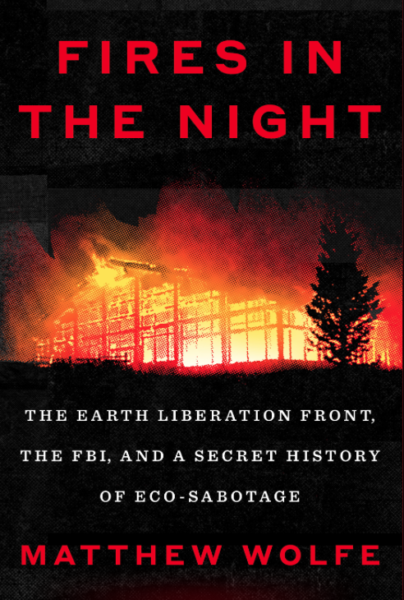
The book opens with the arrest of ELF member Joseph Dibee and with horrific statistics: In the decade between Dibee’s indictment and his 2018 arrest, “humans had collectively added 100 billion pounds of plastics to the oceans and 1.3 trillion pounds of aerosolized carbon to the skies…Approximately 780,000 miles of Arctic ice had melted away, while 225 square miles of Louisiana’s coast were swallowed up by the encroaching Gulf of Mexico. Whole species of animals were blinking out of existence…Despite the lethal absurdity of such a situation—a gun shoved in the mouth of every living creature on the planet—the industrialized destruction was still grinding onward, a ruinous machine that wouldn’t be switched off.”
Fires in the Night takes readers into the backstories of passionate environmental and animal activists from their earliest awakenings—activist Kevin Tubbs’s first act of mercy was rescuing a neighbor’s dog from confinement in a cage—and onward to their ELF involvement and actions to their post-ELF lives, arrests, and sentences.
While readers can certainly empathize with the Elves (perhaps now more than ever), Wolfe’s portrayal of law enforcement officers is equally compelling as he reveals their frustration at the ELF’s effectiveness, the tiny clues that finally led them in the right direction, and the multi-agency cooperation that led to the ELF’s eventual reckoning, which in the post-9/11 crackdown on “ecoterrorists” feels even more chilling in 2026 than in 2001.
The book begins with Tubbs and his choices in the face of the regular, legal violence consistently done to animals: “He could retreat back into a make-believe world and pretend that none of this is happening; he could break down in despair; or he could take action.” He ended up in Eugene, Oregon, which in the 1990s “seemed suffused with a romantic, lawless glow, a young person’s sense of invincibility, of embracing forbidden ideas and being able to tell established power to go fuck itself.”
From there, the narrative takes off: Tubbs connected with other activists, ELF cells began to emerge, and the sabotage began. The Elves, operating in complete secrecy and under the dark of night, realized they needed to share why they were setting fire to forest stations and slaughterhouses and began sending communiques to Portland activist Craig Rosebraugh (whose book Burning Rage of a Dying Planet: Speaking for the Earth Liberation Front covers his time as ELF spokesperson, from 1997 to 2001). Rosebraugh issued these communiques as press releases to the media, and the Earth Liberation Front became known beyond activists and law enforcement.
Fires in the Night reveals the history of the environmental movement alongside the rise of the ELF, from the successful Wagner Creek anti-logging protest in the Willamette Valley to the $12 million arson at a ski resort in Vail, Colorado. These acts of protest and sabotage are as fascinating and dramatic as the backstories and commitment of the ELF members themselves. Wolfe details the measures the Elves used to avoid detection, among them creating incendiary devices in tents in the woods to avoid DNA contamination, using dead drop email to communicate, asking a fellow ELF member for a ride to commit arson without telling them anything about it beforehand, and never speaking about an action after it was complete.
The Elves took great care to ensure no human or animal would be harmed, and they succeeded. The details of their actions—coming together in the dead of night, often for the first time, not knowing whether they’d be caught or whether their devices would successfully ignite—make for page-turning suspense. And in the meantime, the Elves led double lives, with jobs and families and significant others, the rest of the world completely unaware of what they were getting up to. Some of them—including Josephine Overaker, who is still at large to this day—lived under fake IDs. They didn’t talk freely at home or in their cars, using the words like “BBQ” and “picnic” when discussing arson.
Their actions—torching commercial as well as federal buildings—resulted in millions of dollars in damages and got the attention of the ATF and FBI as well as local law enforcement. Wolfe’s vivid, gripping storytelling deftly portrays the ethical nuances of the ELF’s escalating environmental sabotage. Before the ELF attack on the Cavel West horse rendering plant in Redmond, Oregon, locals were dealing with “the horrific smell, the screams of the animals, and the countless gallons of blood it produced, which was so voluminous it would sometimes overwhelm the sewer system and bubble out of their bathtubs,” not to mention the horror and abuse the horses themselves suffered. Yet this slaughterhouse arson took forty firefighters and two million gallons of water to extinguish: considerable human risk and considerable environmental waste. While the ELF saw their methods as nonviolent—especially compared to what was being done to the planet and to animals—setting fires was not without risks.
And Elves themselves wondered whether these risks were worth it. Often, the media would cover the fires but not the reasons they’d been set. Properties were being rebuilt with insurance money, and environmental and animal abusers were going right back to business. One of the ELF’s most ambitious actions, torching a ski resort in Vail, Colorado, on behalf of the lynx and causing $12 million in damages, was met with mixed reactions from both within and outside of the environmental movement.
After September 11, 2001, the stakes changed forever for the ELF. In the early 2000s, with the help of the Patriot Act, the FBI went all in on terrorism. Despite the fact that the ELF had not harmed a single living being, by the bill’s new definition of terrorism (“a terrorist didn’t have to harm someone … They just had to scare them, even with vandalism”), Elves were labeled “ecoterrorists,” and law enforcement was given the staff and funding to hunt them down.
It would take years, however, for the Elves to be brought to justice; they’d operated for seven years without leaving a trace. Yet the post-9/11 world was a terrifying one for activists, even those who weren’t setting fires. Many, especially in Oregon, were being subpoenaed to testify as to what they knew about the ELF. Finally, in 2004, one of the Elves was convinced by the FBI to work with them on getting evidence against other members, and by the next year the arrests began.
Fires in the Night covers the egregiously long sentences the ELF members received, as well as the truly depressing state of affairs after the 2024 election, in which funding for clean energy was scrapped, environmental protections rolled back, the Endangered Species Act weakened, land and water protections removed, hundreds of millions of acres opened for logging, and thousands of staff fired at the Environmental Protection Agency. While the book doesn’t end on a hopeful note, the hope lies within its stories: small cells of passionate humans from myriad backgrounds who came together to fight for animals and the planet.

Midge Raymond is a co-founder of Ashland Creek Press. She is the author of the novels Floreana and My Last Continent, the award-winning short story collection Forgetting English, and, with John Yunker, the suspense novel Devils Island.