
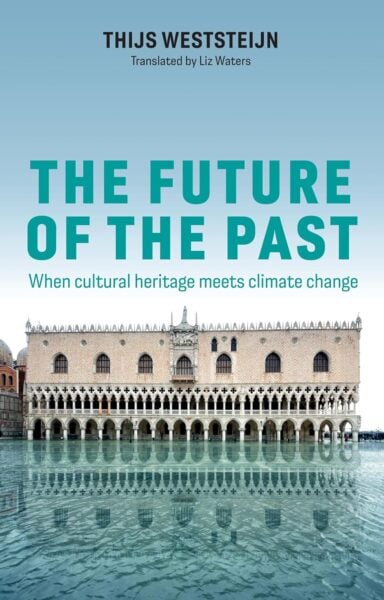
A rather clichéd question consistently asked of curators, connoisseurs and collectors in interviews is: ‘if this place was on fire, what would you save?’ The chosen piece is inevitably of deep personal, cultural, religious or monetary value, and the interviewer moves along within the generic interview framework. However, what if a whole village, town, area or region was on fire, what would a community wish to save? What would the rest of the world wish for that community to save? Professor Thijs Weststeijn’s The Future of the Past – when cultural heritage meets climate change confronts these challenging questions that the accelerating climate crisis renders increasingly urgent. It is as though Willy Loman’s cry in Arthur Miller’s Death of a Salesman that “the woods are burning” has become the defining reality of an age of uncontrollable wildfire. From our bourgeois homes, far from the flames, what would we like these communities to save? How complicit are we in what Weststeijn refers to as Professor Kari Norgaard’s ‘shifting baseline syndrome’ or in our collective ‘doomerism’? Are we relinquishing our cultural heritage to climate change because we do not feel responsible for causing it, or indeed for reversing it? Our baselines have shifted; in our minds, we didn’t cause climate change, therefore we’re going to ignore what is happening. The author explores this concept in relation to the Netherlands and its deep ties to the oil industry, which is ironic, as much of that nation is vulnerable to the effects of climate change as it lies well below sea level, which is itself rising.
Weststeijn reminds us that Field Marshal Kesselring, when retreating in World War II, chose not to blow up the Ponte Vecchio in Florence, even though the other bridges over the River Arno were all being destroyed. Kesselring had agency to cherry-pick what heritage should be retained. There is an assumption, therefore, that we too can choose the cultural heritage we wish to preserve, that we still have agency to decide and curate our cultural heritage into the future. Or do we? Perhaps extreme weather events will decide that for us. Weststeijn gives limited attention to the impact that blowing up the other bridges over the River Arno, or indeed World War II itself, had on ecologies, as he is focused on the anthropocentric conception of cultural heritage. Cultural heritage, such as the Ponte Vecchio, is derived from, and directly engages with, the more-than-human sphere. Weststeijn uses Yuval Noah Harari’s remark that any corrosion of the Wailing Wall in Jerusalem causes more outrage than the demise of the Amazon region, which supports life on Earth, as an example of the deference humanity shows to anthropocentric culture rather than to, or including, the more-than-human. Extreme weather events, rising sea levels, and displaced populations may limit our ability to decide which cultural heritage to cherry-pick to save. Perhaps Weststeijn is correct to postulate that humanity is experiencing ekpyrosis, which the Greek Stoics believed to be the cyclical destruction of the world and its rebirth, and we may be just caught in the crosshairs.
By referencing Ozymandias, Weststeijn almost aestheticises cultural destruction: “Look on my works, ye Mighty, and despair”; or in other chapters, the looming destruction of Venice adds to its cultural appeal by casting a temporality over its perceived beauty. In Ozymandias, Percy Bysshe Shelley focuses on the despair at the demise of human accomplishment. Conversely, I would posit that the unaddressed counter view is the demise of ecologies for the sake of human accomplishment. This opposing view is exemplified in works such as Gerard Manley Hopkins’s ‘Binsey Poplars’, which may balance Weststeijn’s emphasis on cultural anthropocentrism;
“My aspens dear, whose airy cages quelled,
Quelled or quenched in leaves the leaping sun,
All felled, felled, are all felled”.
The potential salve could be the ‘cathedral thinking’ concept Weststeijn mentions for repairing ecology and adapting behaviours. However, whilst referencing this concept, the author initially appreciates its ecological resonances, yet, in his epilogue, strays from them by arguing that it is the human species that can save historical heritage, since humans created it. Such an anthropocentric outlook could be argued to be the reason we are facing climate change in the first place. A full reassessment and adaptation of how humanity interacts with, respects, and coexists with the more-than-human environment are necessary not only to mitigate the impacts of climate change but also to consider how we move forward in our ‘cathedral thinking’ collectively. We must consider the more-than-human in any efforts to sustain cultural heritage; otherwise, it perpetuates an extractivist anthropocentrism which only exacerbates climate change.
Weststeijn also states that heritage “never becomes an unmanageable ‘hyperobject’”, referring to the dark ecology theory of Professor Timothy Morton. I disagree. Cultural heritage is distributed across immense spatial and temporal scales and continually expands through discovery, reinterpretation and digital preservation. Due to these characteristics, it functions as a hyperobject. As a hyperobject, cultural heritage is unmanageable because of its vast distribution across time and space, as well as its liminal boundaries: what can actually be included? Cultural heritage continually emerges and vanishes as ice sheets melt and rivers dry, shifting in relevance and meaning due to changing media and political upheaval. This dynamic process affects not only humanity but also the more-than-human sphere. The more-than-human world continually interacts with our architecture, infrastructure, agrilogistics, and the sensory landscapes through which we experience ourselves and the world. Therefore, our cultural heritage is inseparable from the more-than-human, because it is derived from it, and will inevitably, in the short, medium or very long future, return more fully to it. The vivid examples that the author refers to throughout his writing; the Dunn family graves on Viti Levu Island, Fiji; the 38,000 Italian historical monuments at risk of landslides; and the 250,000 artworks removed from the Louvre due to its proximity to the River Seine, are enough to determine that cultural heritage is unmanageable in the context of climate change.
Weststeijn raises an interesting supposition by Arthur Danto, that the visual arts have degenerated into intellectual tomfoolery that don’t go beyond self-commentary and have reached the end of their historical development. If the historical trajectory of art is no longer defined by self-reference alone, climate change offers an opportunity for artistic praxis to reconsider its relationship with ecological systems. Perhaps this could take the form of advocating for adaptation to climate change and for engaging fully with the more-than-human through ecological art, ecoscenography, ecodramaturgy, or other regenerative art forms. Weststeijn’s book places the discourse of cultural heritage on the precipice of climate change. Questions concerning cultural heritage amid climate change are highly potent, and Weststeijn elicits them in the reader adroitly, without offering substantive solutions. His experiential view of Amsterdam, with its wealth of heritage and art now under threat, can be replicated by his cultured peers in cities and regions across the globe, and these voices need to be heard and aligned with regenerative solutions. Cultural destruction is applicable to our own lives, villages, communities, regions and nations. When the fires and floods come to our door, what will we try to save, or will climate change take that agency to decide from us?
Ben is a PhD Researcher in environmental aspect of the arts. He is a trained architect, urbanist, artist and gardener and cares for the natural world. He is an alumnus of The King’s Foundation in the UK, Foster+Partners Architects London, and a former Course Director of the British, Irish and Australian Academies of Garden Design.