
Collaborative relationships between species are widespread in ecosystems across the planet. One I’m most familiar with is between a tree that grows near my home in New Mexico, the piñon, and the pinyon jay. The bluish-grey jays nest in healthy piñon trees, and rely on a harvest of piñon nuts. They wrestle them out of the cones, inevitably scattering and burying a few in the process, and these lost nuts seed new trees. Evolutionary biologist Rowan Hooper’s latest book Togetherness: Symbiosis and the Hidden Story of the World’s Greatest Collaborations is filled with stories like this—but weirder and way wilder. As I read, I peppered my family text thread with many of the far-out facts I encountered, such as, “there are 2.5 million ants for every human!”
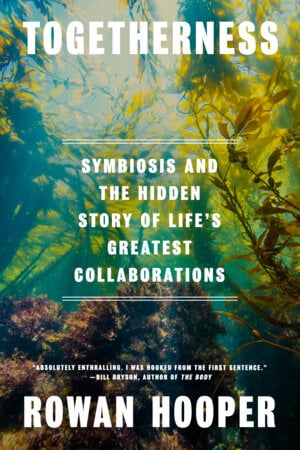
Reading Togetherness is like absorbing a David Attenborough Planet Earth series on symbiosis with a healthy dash of the history and future of the science. Continuing in the vein of Suzanne Simard’s Finding the Mother Tree about the wood wide web and Robin Wall Kimmerer’s Braiding Sweetgrass about Indigenous wisdom and plant teachings, Togetherness explores ideas of interconnectedness with a wider lens. From an Atlantic forest in Brazil to learn about the intertwined lives of figs and wasps, to swimming with a shoal of barracuda near a coral reef off of Borneo, to rewilding efforts on a Welsh farm closer to Hooper’s home in London, Togetherness takes a global look at our ecological relationships, the importance of biodiversity, and what is at stake for all of us if we allow further environmental degradation.
Charles Darwin wrote about nature’s entangled lives in his 1859 The Origin of the Species and Hooper uses Darwin’s journey of discovery as a throughline to connect the contemporary study of symbiosis with the history of evolutionary biology in Togetherness. But as Hooper explains, Darwin was influenced by rapid industrialization and the politics of his time: “It was easier for [Darwin] to make a strong case for natural selection by emphasizing the competitive side of things. The struggle for existence and the survival of the fittest were easier to measure and easier to sell.” Hooper argues that because of this insistence on competition in Darwin’s work and those that followed, the study of symbiosis has never been fully accepted by mainstream science. Even after the 1960s, when Lynn Margulis established that all of our cells and everything around us came from symbiosis between two organisms, Hooper notes that “we do still focus on competition.” He hopes that Togetherness can help “redress the balance.”
Readers may know Hooper from his previous books Superhuman: Life at the Extremes of Mental and Physical Ability and How to Spend a Trillion Dollars: The 10 Global Problems We Can Actually Fix, or his many years as an editor, and now podcast host, at New Scientist, though for full disclosure I admit that I did not. No, I stumbled onto the title in a list of forthcoming science books, a moment of serendipity that encompasses what I love about book browsing: finding the unexpected.
Togetherness offers a lot of surprising and unexpected tales. Take for example, the scaly-foot snail living near a deep-sea hydrothermal vent, with a bacteria filled organ that takes in sulphur and iron and turns it into a metal armor. Or how the Acacia ant protects the thorny Acacia tree from visiting herbivores in exchange for housing and nectar. Or Pando, an aspen grove in Utah comprised of 47,000 genetically identical aspen tree stems that researchers believe to be somewhere around 34,000 years old. Or that coral reefs make their own clouds. I could go on, and my family will tell you I did. While I could have done with fewer pages on Darwin and I found myself skimming through a bit of the history of evolutionary biology, I was surprised and drawn in by the book’s third act, where Togetherness swerves to explore symbiotic relationships in agriculture.
Hooper opens this section with the example of the Three Sisters—an Indigenous tradition common in the area of the Southwest where I live—growing corn, beans, and squash together. The corn stalk provides support for the beans to wind their tendrils around, the beans take nitrogen out of the air, and the squash leaves keep the ground free of weeds and prevent water loss. Hooper contrasts this kind of polyculture growing and the benefits of biodiversity with the disastrous effects of massive industrial monocultures. Over-farming and fertilizer and pesticide pollution lead to the opposite of symbiosis: dysbiosis, or imbalances between organisms, which once shifted are difficult to repair. This final act serves as a call to action, centering not on climate change—though this is clearly tied in—but on how we farm and what we eat and how these systems are all connected.

Becca Grady (she/they) is a queer writer, photographer and artist whose writing was chosen in the Open Mountain Competition at the Kendal Mountain Literary Festival and has been published in Elsewhere, Perverse, Ecology and Action Magazine, and Composite Arts Magazine. Becca’s work has been supported by fellowships, workshops and grants such as Bread Loaf, Granta, Tin House Workshop, Pocoapoco, ACRE, the Katharine Bakeless Nason Scholarship, and a ChancesDances Critical Fierceness award. She lives with her partner and dog in New Mexico, US. More at beccagrady.com.