
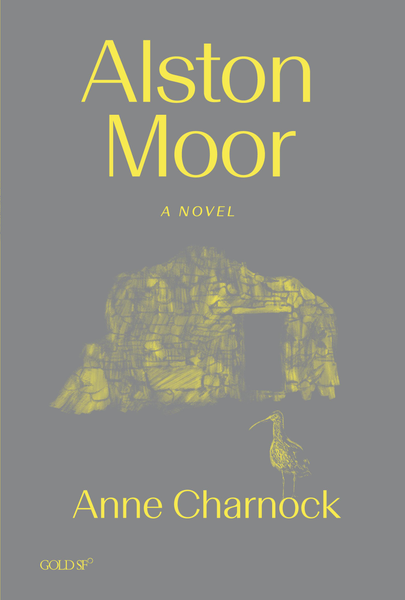
Review: Alston Moor
by Anne Charnock
Goldsmiths Press, University of London, 2026
I find myself distracted by people within earshot at exhibitions or museums, with their inane chatter, phone noise, and lack of spatial awareness. Since the Covid-19 restrictions ended, crowds have surged, swarming around cultural artefacts for social media trends. I occasionally visit when buildings are empty, recalling a memorable visit to see the early medieval Fadden More Psalter at the National Museum of Ireland, where my partner was on the Museum Board. The psalter was found in a bog, preserved by low oxygen and sphagnum moss. Later, we viewed seventeen priceless manuscripts from the Abbey Library of St Gall in Switzerland, loaned to the museum. We learned of the recent, exciting scientific discovery that the most decorated manuscripts from this collection were originally from Ireland. The illustrations, colours, and script were mesmerising. The fragility of these works of art and their survival for over one thousand years instilled a hushed respect throughout the exhibition, which may also have stemmed from their religious significance and iconography. The silence and reverence made it one of my favourite museum visits. I remember the ancient manuscripts’ tea-stained colours, the illustrators’ skill, and the thrill of realising these could have been destroyed by exposure to air, as with the Fadden More Psalter.
Reading Anne Charnock’s new eco-fiction novel, Alston Moor, reminded me of this museum visit, a memory I had stored away as an artefact in my collector’s memory cabinet. Charnock’s writing unknowingly summoned that memory for me. The author weaves two stories together with such ease that, upon finishing one chapter, I wanted to know what would happen next, picking up the sequential threads of each story, much like watching two TV series consecutively. The first follows a contemporary student with a malevolent streak, sent to do some reparative conservation work in the boglands, and the second is an historical tale of the tribulations of life on Alston Moor five hundred years earlier. She shifts between characters in the two stories with ease, and the characters are compelling, their narratives linked by the same landscape but separated by centuries.
After a summer of heatwaves in which many bogs were burned, her novel is timely. The more I read Charnock’s novel, the more I wondered why I had never previously considered how bog fires started. Even here in Dublin, we seemed strangely accustomed during the past hot summer to drifts of smoke coming from the mountainous boggy areas to the south of the city. The author peers into the quandary of environmental responsibility and the exhaustive efforts of some to preserve our endangered and highly fragile boglands. She does this with exquisite realism, and I felt that I knew her characters. Charnock’s assured atmospheric writing succeeds because the emotional lives of her characters remain recognisable, despite the five centuries separating the two narratives.
From my collector’s memory cabinet, I recalled that the boglands near where I grew up were still being mechanically stripped to provide a growing medium for the mushroom industry, with much of the resulting produce exported. As a child, and later as a teenager, armed with a small, provided knife, I worked weekends and school holidays in the mushroom-growing industry. The blue rubber gloves would fall apart on our hands from using the blade; scum developed from handling mushrooms, mixed with the perspiration on our hands, and the heavy, wet, black growing medium that contained what looked to me like lumps of bog turf. It was mind-numbing work, and the days were long in the humid plastic buildings, caked in a never-ending froth of white mushrooms. When the growing medium was spent, it was dumped into holding areas in huge mounds of steaming, stinking blackness. Despite being sodden and, by now, a waste product, we were sometimes given some to use as garden mulch. Charnock’s description of the bog slide reminded me of shovelling spent mushroom compost off the back of trailers, and how it would start to move and slide downwards of its own volition if it rained. Sometimes I would find a disused blue rubber glove in the blackness, the closest thing to a bog body or bog butter that I would find.
Archaeological objects recovered from our boglands are celebrated, as though the earth has given us back something remarkable of our own culture. However, less is done to celebrate the bogland’s environmental complexity and its ability to preserve these fragile objects. Charnock found her story at the intersection of environmental responsibility, dark ecology and historic culture, with the moor as a broodingly silent character. An aspect I particularly enjoyed in Charnock’s writing was the closeness of some of her characters to the landscape, the seasons, and the craft evident in the devotional religious objects. Juxtaposing this historic closeness to the environment with the malevolence of a troubled youth creates a tension that draws Charnock’s readers in. The faceless medieval raiders plundering the landscape around Charnock’s Alston find their contemporary counterparts in the baleful hands setting the boglands on fire for unknown reasons. Perhaps we don’t want to know why they destroy these landscapes because the reasons given will reveal something about our culture or ourselves that we don’t like or do not wish to know. It may cause us to consider who is worse: the person who sets the bogland on fire, or the industry that mechanically strips the bogland, layer by layer, to serve the mushroom industry? As the characters in Alston have their role to play, Charnock makes me ask: what is our role in the destruction of the boglands and wider ecologies? Just because we do not ignite the match doesn’t mean we are not contributing to the destruction of boglands in other ways.
I hope that when you read Charnock’s Alston Moor, which I recommend you do, it will prompt you to search your own collector’s memory cabinet and reflect on how you have treated the wider environment in the past. Perhaps reading about the people of Alston will prompt an appreciation for our long, complicated cultural history of working with and being completely dependent on nature. Perhaps it may even inspire you to overcome the awfulness of museum crowds, seek out some of the fascinating objects preserved in our boglands, and consider whether the fragile landscapes that preserved them deserve the same reverence as the objects themselves.
Ben is a PhD Researcher in environmental aspect of the arts. He is a trained architect, urbanist, artist and gardener and cares for the natural world. He is an alumnus of The King’s Foundation in the UK, Foster+Partners Architects London, and a former Course Director of the British, Irish and Australian Academies of Garden Design.