
By Robert Epstein
Regal House Press, July 2026
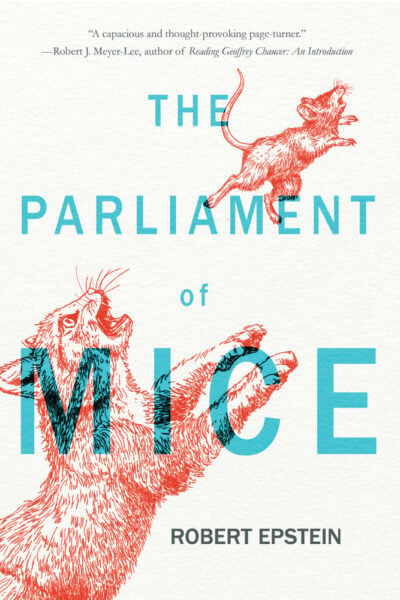
When was the last time you read a fable, or, more likely, had one read one to you? As a child? In Folklore 101 at college? Maybe it’s time to revisit. Animals have always been used in storytelling as a mirror on our own sorry human selves, and The Parliament of Mice, a Fable, by Robert Epstein is no exception. While keeping within the formal syntax of a traditional fable, the writing itself is lovelier than that. Even the epilogue sings: “Somewhere under the sun on a petty scratch of earth hunched an old house and an old barn that listed towards each other as if they longed to collapse in an embrace.”
The book’s main plotline is grounded in the belling of a cat, always a fraught endeavor. Our hero is Frobert, a house mouse in love with a barn mouse, Ébènette. While courting her, Frobert is shocked at the conditions the barn mice are living in, with minimal food and under the threat of a formidable barn cat, Belle. The house mice live with a fat lazy cat, “closer to upholstery than a cat,” and an owner with less-than-ideal housekeeping skills, so that food is always abundant. “How could one set of creatures endure grinding deprivation and predation, while just a few steps away another set, identical but for accidents of geography, enjoyed ease and abundance?” Frobert asks. In his search for answers, he discovers that the mice have a parliament and hopes to petition it for justice. Poor Frobert. So much to learn about governing bodies. As his friend Pelez says, “On available evidence, I’d say its chief priority is jack shit.” It’s worse than that. An elder mouse, Old Gras, is in cahoots with Belle, and neither want the gravy boat to spill. And yet, Old Gras is contemptuous of the cat: “Those in power, he ruminated, are always certain that their privilege derives from their own merits. They can never see the mechanisms propping them up.”
As the plot churns within the machinations of the mouse parliament, other stories featuring fox, wolves, humans, and other creatures are woven throughout, many of which concern inequality between the sexes. Said the fox vixen to Blanche, the hen: “I am talking about the web of suffering and sorrow that ensnares all women and only women, of any and all species.” Since these are fables, you can count on a comeuppance. These fables are well aware that they are fables. A human boy consults with “maman” goose for a healing story whenever he is low, and she often interrupts herself to ask how he would like the story to end. Traditional or alternative? If he doesn’t like one ending, there is always another. The rooster is prone to telling fables himself, but Blanche scoffs at his stories about female submission. “They are not just stories, Blanche,” said the cock severely. “These are famous tales, given to us from the most respected authorities.” “Authorities!” said Blanche. “Do you think a listener cannot recognize your strategies, your tricks to give the impression of verisimilitude? … They may be biblical or they may be epic or they may be passed around the tavern, but you narrate them in ways to make them more effective while you make them mean whatever you want them to mean.” Ouch.
One of my favorite parts was watching how the former barn cat, once a ruthless killer, changed when her situation changed. “I am lady of this house now. I have a position that suits my skills and my dignity. I keep order here. The people appreciate me, the mice fear and respect me.” And what of Frobert? I won’t spoil the ending, but suffice it to say, he weighs the pros and cons of having a Parliament: “Had he asked too much of it? It seemed now that he had asked too little.”

JoeAnn Hart writes about the pervasive and widespread effects of the climate crisis on the natural world and the human psyche. Her most recent book, Arroyo Circle, a story of reclamation in a time of loss, was released by Green Writers Press in 2024. Her other books include the prize-winning environmental and animal fiction collection Highwire Act & Other Tales of Survival, the crime memoir Stamford ’76: A True Story of Murder, Corruption, Race, and Feminism in the 1970s, as well as Float, a dark comedy about plastics in the ocean published by Ashland Creek Press, and Addled, a social satire. She is a regular reviewer of climate and animal fiction at EcoLit Books.