
Akashic Books, June 2026
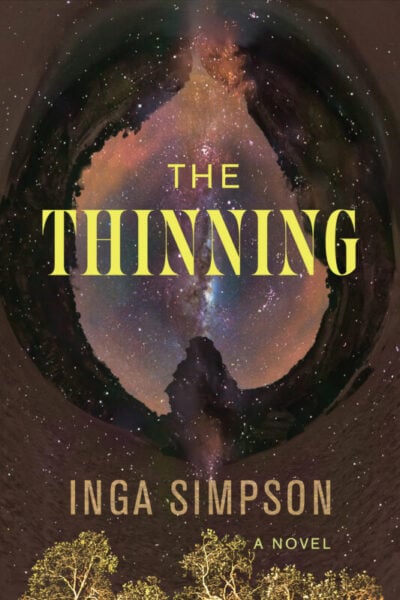
When the U.S. Supreme Court overturned federal abortion rights in 2025, there was a lot of chatter on social media telling women to delete their menstrual cycle apps, because the government could access that information and prosecute for a suspected abortion or miscarriage. The government would know when they were fertile. In another country, in a future time, this situation sparks the plot of The Thinning, by Inga Simpson, a novel which manages to be both horrifying and hopeful. Set in Australia after an extinction event called the Great Thinning, the human population has been reduced to such a degree that females from age ten up must be micro-chipped so the state can record their cycles, as well as submit to invasive exams, part of a program to save the species. First, it was for egg harvesting, and then for impregnation with eggs fertilized by the Incompletes, a new generation of humans born with large, short-sighted eyes, with brains made for screens. “People call them Incompletes because they cannot reproduce. Not with each other, anyway.” So, Finley, the teenage protagonist of the story, and her family do what I would do. Run.
Finley’s family had been part of an important observatory community, where her dad was the head astronomer. Her mom, Dianella, is an astrophotographer, famous for a photo that showed the effects of satellites on the Dark Skies. This observatory was bought and closed by MuX, the corporation who had filled those skies with satellites in the first place. When the novel opens, Fin’s family has also thinned out. Her father died of lunar silicosis from breathing in moon dust carried back to Earth on equipment and rock samples, “which clung to everything, especially the inside of human lungs.” So, it’s just Fin and Daniella, along with many of the observatory’s staff, who had been living off the grid for months in the wilds of Australia, growing what they can and killing feral goats for meat. The government knows them as the Illegals. The koalas are extinct. The Great Barrier Reef is dead. The world is greatly diminished, but Fin is still alive to the natural world, and so she sneaks off from the group for a swim in a creek, which smells like “Callitris resin, damp soil, scat, wet fur.” She is spotted by a young Incomplete, which means the group has to abandon their encampment, and no one is happy with Fin. Then they are forced to rescue the Incomplete who had spotted Fin. His name is Terry, and he has lost his parents. No one, including Fin, is happy is having him there. Terry is vulnerable and ill-suited for the outdoors and is being hunted down by the government for his extrasensory abilities.
The adults have a plan which they do not share with Fin and Terry, but they are very much part of the operation. As if in a fairy tale, Daniella tells her, “You have three tasks.” The first is to mail an envelope addressed to one her dad’s friends, an editor of an independent online journal. “The world needs to know what’s happening.” The second is for Fin to climb to the top of Kaputar mountain for a total eclipse which is about to take place in a couple of days, and then to signal with a laser light. The third is to take a black box with her for safe keeping. On top of all that, she has to take Terry along. Fin is not unprepared for this difficult journey, because her parents had viewed problem-solving as a self-sufficiency tool for the world she would be inheriting. Through all Fin’s travails, in which the state is constantly one step behind, they come up against the sheer beauty of the world. “The understory is all silver wattle and blackwood on a carpet of snow grass. It’s another shift, the air crisp and sharp, subalpine.” But they also face the earth’s heart-wrenching degradation. “We’re into the gas fields, a sea of shiny pipelines and well heads, murky gray pools. Jets of flame roar high in the air, uncapped.” Through it all, Fin’s eyes are in the skies. The Thinning is full of astronomy, without ever seeming academic. “When we look at the stars, we’re actually looking into the past. And the farther away we’re looking, the farther back in time we’re seeing. We see the sun as it looked eight minutes ago, and Sirius the way it appeared in the seventeenth century. We can’t even be sure that anything we’re looking at is still there.”
The eclipse is the ticking clock, and they have always portended the end of one thing, or the birth of something else. On their way to the mountain, Fin finds pink slugs, thought to be extinct, and they are both thrilled. “Do you think they know that they’re on the brink of extinction?” Terry says. “Do we?” asks Fin. The eclipse itself is wonderfully evoked. “It’s beautiful—and terrible. Earth, Moon and Sun are revealed for all they are: giant spheres, locked in orbit …The universe is so, so large, and we are so small, just specks, and only here for a moment.” I won’t reveal what the adults have been doing this whole time, but it all comes together in a satisfactory way. Do not skip the Author’s Notes at the end, which are fascinating and heart-breaking. Simpson writes about the fracking of the Great Basin, one of the largest bodies of underground fresh water in the world. A portion of the author’s profits will go to fight the Santos Narrabri Gas Project. Even in this, there is hope. As Fin says, “Nothing stays the same. Not even the stars.”

JoeAnn Hart writes about the pervasive and widespread effects of the climate crisis on the natural world and the human psyche. Her most recent book, Arroyo Circle, a story of reclamation in a time of loss, was released by Green Writers Press in 2024. Her other books include the prize-winning environmental and animal fiction collection Highwire Act & Other Tales of Survival, the crime memoir Stamford ’76: A True Story of Murder, Corruption, Race, and Feminism in the 1970s, as well as Float, a dark comedy about plastics in the ocean published by Ashland Creek Press, and Addled, a social satire. She is a regular reviewer of climate and animal fiction at EcoLit Books.