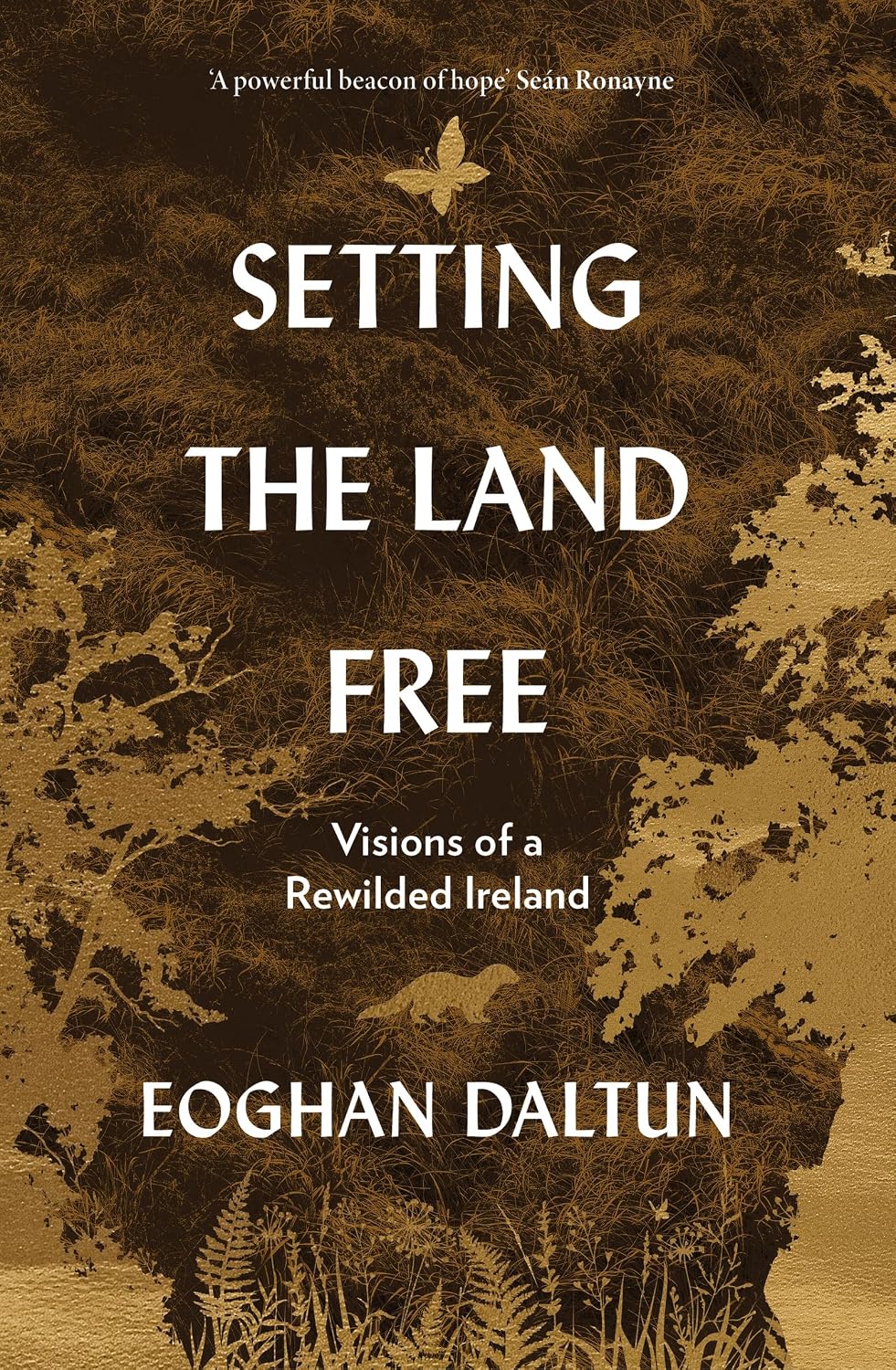
Book Review: Setting the Land Free: Visions of a Rewilded Ireland
Eoghan Daltun
ISBN: 9781399749473
Format: Hardback
Daltun’s latest book is a timely successor to his wonderful An Irish Atlantic Rainforest, which I equally enjoyed. In his latest work, he writes about those he has met who are undertaking rewilding initiatives across the island of Ireland, as well as in Costa Rica and Scotland. The significance of his writing extends well beyond the Irish context, as the ecological challenges underpinning rewilding transcend national boundaries.
His latest book brought me back to the COVID-19 lockdowns, when, following a series of life-changing events, I was living with my parents again. To escape that strain, I would retreat daily into the countryside and the local woodlands on the far shore of the lake. Whatever the weather, the routine of walking the woodlands was important. I marched through them at first, but as the days stretched into weeks and months, I began to slow down and absorb the surroundings. Sometimes, I would just stand perfectly still, and after some time, the woodlands would start to reveal their more-than-human cast members, entering from stage left, right and the orchestral pit. About halfway up the woodland hill, there was a long-fallen beech tree, covered in mosses. One day, stretching out on its trunk to gaze at the woodland canopy moving in the wind, I seemed to lose track of time. When I eventually moved, I noticed I was not alone, for a small red squirrel was beside me on the fallen tree trunk. I looked at it, and it looked at me. I had never seen a red squirrel up close before, and then suddenly, it was gone, up into the canopy, a proscenium of swaying branches in the wind.
As the lockdown days progressed, I saw my first pine marten in the same woodland, moving as fast as an eye floater across my field of vision, darting through the dappled stage lights of the canopy breaks. I was frightened as a goshawk swooped through the trees, but eventually came to know where its carefully situated nest was built. Every day, I would wonder what I would see next, sometimes nothing, and sometimes everything, depending on what performance cameo the woodland felt like offering. What I learned was that the more I disappeared, the more I retreated into absolute stillness, the more the woodland would offer me. Perhaps I was being rewilded myself to some extent, being brought back to the solitude of a youth spent in the countryside during weekends and holidays, away from the strain of home. Perhaps it was a renewed appreciation of ecology, in the same way that Daltun describes some of the characters in his own eco-performance reacquainting themselves with the more-than-human. These characters all arrive at the same undeniable truth: that we, all of us, must act to save the ecologies of which we are part and allow the more-than-human to return to the stage to play their part.
An aspect I particularly enjoyed in this book is that Daltun engages with ordinary people assuming ecological responsibility. Often the narrative around rewilding is dictated by class, privilege or elitism, raising questions about the very anthropocentric and extractivist structures that have contributed to the need for rewilding. I don’t want to read about another colonial estate rebranding itself as a nature reserve, or a landlord excluding communities from the rewilding process. I want to read about all sorts of people engaging with the concept. What Daltun is writing about – I want to hear about it being taught in schools and as part of religious teachings, to give ecology space. I also appreciate the way Daltun, like a handful of others, is now beginning to name the organisations and individuals he considers responsible for the mismanagement of publicly owned land, while challenging the ecological understanding of political decision-makers. The privately owned farms of Ireland also need to engage with the subject in a meaningful way. Like Daltun, I cannot look at the green landscape of Ireland without the depressing realisation that it is currently so ecologically depleted; the scenography of our lives is dying.
Perhaps we also need to interrogate the prevailing structures of agricultural landownership in Ireland. These have been shaped by centuries of colonialism, land reform and intergenerational inheritance (McGrath and More 2024). Yet, despite the historic democratisation of Irish agricultural landownership, just 13.4 per cent of Irish farm holders are women, while 80 per cent of identified farm successors are male (Teagasc 2026). Daltun writes that one of his rewilding characters found that subjects such as flowers and butterflies were considered “unmanly” down in the local pub (Daltun 2026, p. 101). Might greater diversity among people who own, manage and inherit our agricultural landscapes facilitate a broader range of ecologically sensitive approaches? Rewilding, perhaps, requires not only a transformation of our landscapes but also a reconsideration of the structures through which they are inherited, managed and imagined.
An interesting aspect of Setting the Land Free is the question of whether to retain established non-native plants or remove them (Daltun 2026, pp. 102, 307). I can understand the author’s strong inclination towards native species and natural regeneration; however, in an urban context, there are historic trees and hybridised habitats worth considering. As global temperatures rise, I wonder how an exclusively native-species approach might respond to changing climatic conditions in the long term. Perhaps a distinction needs to be drawn between invasive non-native species and established non-native species that contribute positively to existing ecologies. Nevertheless, the importance of ecological mutualism should not be underestimated.
The uninhibited fecundity of goats and deer in parts of the country, as described by Daltun, is worrisome, as indeed is the approach of the National Parks and Wildlife Service (Daltun 2026, p. 315). As an author, he is brave to address the particular strata of the NPWS that he feels are problematic, and his writing raises the serious question of how engaged State organisations are with ecological responsibility. Daltun is correct to include the Office of Public Works, Bord na Móna and Coillte in the discourse (Daltun 2026, p. 301), as State organisations need to do much more, particularly given the environmental commitments of the Paris Agreement, adopted in 2015 (UNFCCC 2015), and the Kunming–Montreal Global Biodiversity Framework, adopted in 2022 (Convention on Biological Diversity 2022).
Rewilding should not be confined to private landowners or those fortunate enough to possess, through inheritance or purchase, extensive tracts of land. The Minister for Education alone owns sites accommodating 390 schools across the Republic of Ireland (Department of Education and Youth 2026, p. 23). More broadly, the Irish school system comprised approximately 4,000 schools during the 2024/2025 academic year, with most children attending State-funded, non-fee-charging schools (Department of Education 2025, pp. 4–5, 7). Imagine the ecological and educational benefits if the Department were to introduce a meaningful programme of habitat restoration across its property portfolio and encourage similar initiatives throughout the wider school network. What better way to educate the next generation about ecological responsibility than to allow children to be actors in the recovery of biodiversity within their own school grounds? Rewilding could become not merely something taught in the classroom, but something experienced daily. What about the landholdings of the Catholic Church, the Church of Ireland and local authorities, or the grounds of Gaelic Athletic Association clubs? What ecological benefits might be realised if these institutions and organisations collectively embraced rewilding as part of their responsibilities to the communities they serve?
I enjoyed and respected all of Daltun’s rewilding characters; however, the one I particularly enjoyed learning about was Aaron Kelly from West Belfast (Daltun 2026, p. 320). Aaron’s journey from an unlikely eco-child of Ballymurphy to stewardship of Black Mountain was wonderful. I admired his positionality as someone who, in many ways, appeared to be an outsider to the sector he is so passionate about. Aaron seemed to possess pragmatic common sense and a capacity for self-reflexivity. His on-the-ground experience of navigating divergent viewpoints appeared to enable him to earn the community’s trust and respect.
Daltun’s book is one that deserves to be widely read, not simply by those already sympathetic to rewilding, but by farmers, landowners, politicians, planners and educators. Its significance lies not only in its examination of how we might restore ecological abundance, but also in how we might reconsider our own place within that ecological performance. What are we doing in our own lives to assume environmental responsibility and reconnect with the wild?
Perhaps rewilding begins with an acknowledgement that we are not the sole protagonists in the ecological theatre of which we are part. Sometimes, as I discovered in that woodland during the COVID-19 lockdowns, the most revealing thing we can do is to remain perfectly still and allow the other cast members to emerge and fill us with awe.
I would recommend reading Setting the Land Free alongside Daltun’s earlier An Irish Atlantic Rainforest. Together, they constitute a compelling invitation to reconsider our relationship with the performance of the living world.
References
Convention on Biological Diversity. (2022). Kunming–Montreal Global Biodiversity Framework [online]. Decision 15/4, Conference of the Parties to the Convention on Biological Diversity. Available from: https://www.cbd.int/doc/decisions/cop-15/cop-15-dec-04-en.pdf [accessed 28 November 2026].
Daltun, E. (2026). Setting the Land Free: Visions of a Rewilded Ireland. Hachette Books Ireland.
Department of Education. (2025). Summary Note: Primary and Post Primary Education in Ireland [online], January 2025. Available from: https://assets.gov.ie/static/documents/summary-note-on-primary-and-post-primary-education-in-ireland.pdf [accessed 28 November 2026].
Department of Education and Youth. (2026). Briefing for Committee of Public Accounts: Planning and Building Unit Overview 2026 [online]. Houses of the Oireachtas, April 2026. Document reference R-2026-0200 PAC. Available from: https://data.oireachtas.ie/ie/oireachtas/committee/dail/34/committee_of_public_accounts/submissions/2026/2026-04-10_briefing-document-ms-bernie-mcnally-secretary-general-department-of-education-and-youth-r-2026-0200-pac_en.pdf [accessed 28 November 2026].
McGrath, G. and More, S. (2024). Farm fragmentation in Ireland. Veterinaria Italiana [online], 60(4). Available from: https://doi.org/10.12834/VetIt.3484.29173.2 [accessed 28 November 2026].
Teagasc. (2026). Women in Agriculture: 80% of farm successors are male. Teagasc | Agriculture and Food Development Authority [online], 7 September 2026. Available from: https://teagasc.ie/news–events/daily/women-in-agriculture-80-of-farm-successors-are-male/ [accessed 28 November 2026].
United Nations Framework Convention on Climate Change (UNFCCC). (2015). Paris Agreement [online]. United Nations. Available from: https://unfccc.int/process-and-meetings/the-paris-agreement [accessed 28 November 2026].
Ben is a PhD Researcher in environmental aspect of the arts. He is a trained architect, urbanist, artist and gardener and cares for the natural world. He is an alumnus of The King’s Foundation in the UK, Foster+Partners Architects London, and a former Course Director of the British, Irish and Australian Academies of Garden Design.