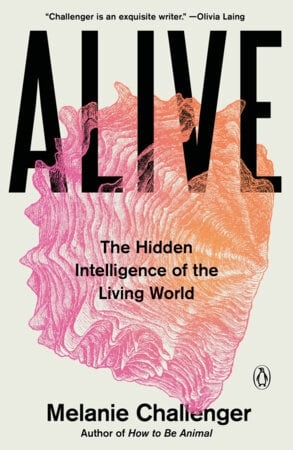
Reading Challenger can be challenging. Her new book brings together the complexity of mind, of life, of lifeways in a stream of examples. Alive: The Hidden Intelligence of the Living World is a multidisciplinary endeavor, a dense read, packed with enough references to serve as the literature review for more than one dissertation.
That density is also the measure of the depth and breadth of her work. Across a career that includes the poetry collection Galatea (2006), On Extinction: How We Became Estranged from Nature (2011), How to Be Animal (2021), and the edited collection Animal Dignity (2023), Challenger repeatedly returns to the question: what does it mean to be one creature among other creatures? Alive is her most ambitious attempt to explore it, by asking what life is and why living beings act as though their lives matter to them? From the tiniest spore to the largest tree, Challenger investigates how living beings inhabit what she calls the psychosphere.
Her answer begins from a simple premise: to be alive, is first and foremost, to be a body. To be embodied is not an abstract concept. Challenger sets herself against two inherited pictures of life: the organism as a machine run by its genes, and life as an essence that floats free of flesh. In their place she offers the organism as a purposeful, self-regulating agent. Aristotle is her constant guide. She borrows his term psyche, the goal-directed living body, and extends it into a “psychosphere,” a realm of perception, intention, and responsiveness that overlaps and interacts with the material world. Throughout, she brings Aristotle into conversation with current biology and physics.
Choosing Aristotle as a guide, however, is not neutral. The same thinker who gives Challenger her embodied psyche also gave Western thought the scala naturae, the ladder of nature that ranked living things by their kind of soul and later concretized into the Great Chain of Being. His biology also cast women as incomplete men. Feminist scholars have long traced how that ordering of bodies (male over female, human over other animals) served to justify domination. In the Politics, he held that animals other than humans exist for the sake of humans, and in the Nicomachean Ethics, he argued that there can be no friendship or justice with them. Instead the highest goal is human flourishing. Aristotle also measured animal worth by their “traces” of humanness (such as cunning, fierceness, and intelligence). A book that sets out to dismantle the ladder would be stronger for reckoning more fully with its architect.
The landscape
The book covers a lot of ground, perhaps too vast a landscape: plants bending toward light, slime molds solving mazes without brains, birds that sense the Earth’s magnetic field, Greenland sharks that live for centuries. Challenger blends philosophy, biology, and the history of science into a work that goes deeply into what it means to be alive, truly alive. At times the book can overwhelm. There is so much attention to multidisciplinarity that the thread of the argument sometimes disappears beneath the evidence. The examples are the book’s strength. In the bee and the sequoia we find the richness, where an abstract claim becomes a living being doing something in the world.
Where are the animals?
This is where Alive deserves the attention of readers who care about animals. Challenger’s subject is the organism, and the animal is one kind among many. A sequoia, a bee, a Greenland shark, and a slime mold all appear as agents with a stake in their own continuation. This is a needed move, and Challenger takes seriously forms of life that are often overlooked in animal advocacy. Yet, this raises a question. When “animal” is dissolved into “organism,” what happens to the specific moral claims animals make on us? Challenger herself ties the stakes to ethics: once we stop seeing living beings as agents and treat them as objects, harm becomes easier to justify.
“Everything starts to look different when we trust that we are in the presence of a purposeful living being. That small but momentous shift, from skepticism to genuine recognition, has been, in turn, the purpose of this book.” (p. 304)
Animal advocates know this dynamic well, especially in biomedical experimentation. Many readers will want to see Challenger apply this to the lives and deaths of animals other than humans, such as those who are farmed, experimented on, hunted, and displaced. Instead, Alive stays largely at the level of philosophical biology and leaves that application to the reader. That is a surprise from an author who co-founded Animals in the Room, serves as a vice president of the RSPCA, and whose earlier books moved animals from the margin closer to the center.
Why it matters
The metaphors we use for life shape how we engage with it. Machine language, with its programs, vehicles, and survival mechanisms, has long made it easy to treat animals as things. Challenger’s critique of reductionism is, in effect, a critique of that language. Read through an ecolinguistic lens, Alive is an exercise in changing the story. It displaces the story of the gene machine and the story of the disembodied soul and offers in their place a story of purposeful bodies. What it leaves largely untold is the story of what humans do to those bodies. A book that restores agency to organisms gives animal advocates a better foundation than the machine model ever could. Whether it gives them enough, or leaves that work to the reader, is the question I was left with. But if we “collapse all these concepts” into the psychosphere,” where does that leave individual animals? As Challenger herself points out “who or what dominates in the psychosphere matters” (p. 294).
Alive is not an easy read. But taken with patience and in small bites, it will reward readers who want the philosophical groundwork beneath the ethics of how we live with one another on this planet. Despite Challenger’s critique of human exceptionalism, which Aristotle embraced, the book’s organizing constructs, such as emotion and intelligence, remain anthropocentric. And while a spore and a sequoia matter equally in these pages, the concepts arrive so quickly and in such numbers that none receives the fullness other scholars have brought to them.
The book’s stated goal is to help us trust that when we truly see (not merely look at) other beings, we will begin to see our similarities. Yet, measuring other beings by their likeness to us is still an anthropocentric view, one that falls short of the respect that animals are due. Challenger’s own Animals in the Room website puts it differently: “For too long, the world’s decisions have been made in rooms filled only with humans … So we’re going to invite animals in. We’re going to ask for their perspective.” But if we stay at the 30,000 foot level, would they accept our invitation?

Deb Merskin, PhD is Professor Emerita in the School of Journalism & Communication at the University of Oregon.
Deb grew up among the forests, dunes, and beaches of Lake Michigan, where she always found strays, orphans, and hungry four-footed and winged friends. She earned her PhD in Media Studies at Syracuse University. While there, she volunteered in the early days of founding Clearwater Marine Science Center. She is Professor Emerita of Media Studies in the School of Journalism & Communication at the University of Oregon. She earned a second graduate degree in ecological psychology from Pacifica Graduate Institute, focused on human projections onto predators, especially cougars.
Deb moved to Powell Butte in 2018 and has volunteered at Think Wild, Central Oregon’s wildlife rescue, rehabilitation and nonprofit since 2020 in the hospital, on the hotline, in transport and rescue, and at events. She is also on the board of directors. She holds an IWRC wildlife rehabilitation certification and is an OSU Certified Naturalist. She authored Seeing Species (2018), co-created animalsandmedia.org, serves on several animal advocacy boards, and is completing an MSL in Animal Law at Lewis & Clark Law School. Deb is also a fitness and yoga teacher.