
It may be summer vacation for some but not here at EcoLit Books!
Here are the latest selection of books to come across our desks…
Undying Fire: A Fire History of Europe
By Stephen J. Pyne
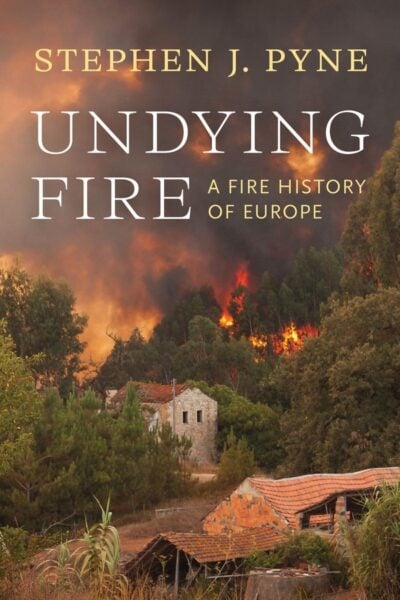
A tragically timely history about fire throughout Europe. A beautifully written book that provides a deep understanding of how fire was viewed, controlled and, ultimately, feared.
This work offers a sweeping history of Europe told through flame–and a history of fire refracted through Europe’s landscapes, sciences, and empires. Drawing on and substantially updating his classic Vestal Fire, Stephen J. Pyne’s incisive new volume follows fire from Iceland’s oceanic fringes to the Siberian taiga and the Mediterranean’s blaze-prone rim, showing how Europe’s peculiar geography, history, and culture forged a singular pact with combustion. Organized in three sections, it moves from the elements of practice and ideas that make up Europe’s core fire narrative to vivid portraits of five fire provinces (Mediterranean, Central, Boreal, Eurasian, and Atlantic) before turning to the global consequences of European expansion.
No More Animal Poems
By Marc Vincenz
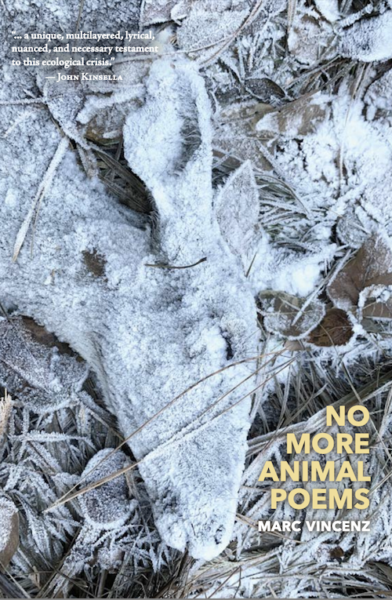
A sharp, witty, lyrical poetry collection targeting ecological collapse by exposing the lethal consequences of our folly and greed.
No More Animal Poems reimagines eco-poetry, forking up what might be called “cosmic cli-po”: climate poems that look beyond a single damaged planet to a whole energetic multiverse.
The poems range widely: ecological crises, vanishing habitats, and endangered species, but their exacting focus is often on us—our greed, our blinkered optimism. Structurally, the book is served as a menu, or perhaps a dystopian omakase, with each poem arriving as a course. These darkly comic gastronomies champion the non-human while skewering our contemporary eating habits, from trendy veganism to luxury food cultures obsessed with scarcity, exclusivity, and status. The result is smart, savage, and funny—a tasting menu designed to make you think, laugh, wonder, dream, create, rebel.
Abolition and the Rise of US Environmentalism
By James S. Finley
By the 1840s, many Americans recognized that the institution of slavery was destroying Southern landscapes while threatening to expand into the West. An increasing number of white Northerners believed that surrounding areas where slavery was legal with so-called free soil would hasten its collapse and forestall an environmental crisis. James S. Finley addresses this understudied intersection of US antislavery and environmental politics in the two decades before the Civil War, arguing that the debate over free soil—what it should look like and who should have access to this land—was an underrecognized precursor of modern American environmentalist movements.
Through the work of a group of Black writers and thinkers, the Free-Soil movement’s white supremacist underpinnings were challenged by an ecosocial vision that centered democratic communities and sustainable labor. By analyzing the output of authors who advocated for truly free soil, such as Frederick Douglass and Henry Highland Garnet, Finley finds commonalities in their attempts to reenvision communal relations between individuals and the land with contemporary movements for racial and environmental justice.
Water, Carbon, Time: Exploring Peatlands in a Warming World
By Jennifer de Mooy
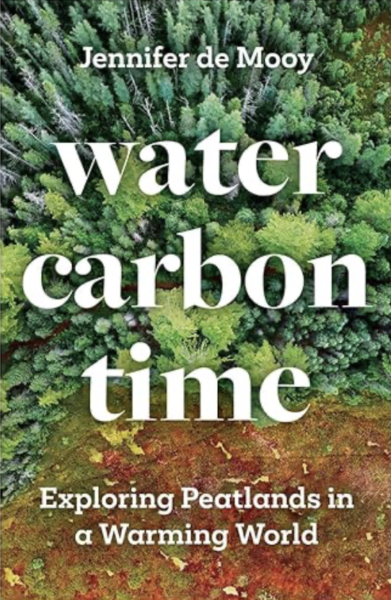
Bogs, fens, mires, moors, muskegs, and pocosins—they are found in nearly all the world’s climatic zones but are easily overlooked. Yet these murky ecosystems are both full of life and crucial to planetary wellbeing: covering only about three percent of the earth’s surface, peatlands store more carbon than all the world’s forests combined. In Water, Carbon, Time, Jennifer de Mooy shares her discovery of these natural wonders, bringing attention to the restorative possibilities of their spongy depths.
De Mooy first encountered peatlands on a trip to Ireland, but her later work on climate policy in the United States led her to ask: could peatlands help combat global warming? To find out, she traveled from bogs and fens in Minnesota and Maine to bofedales in Peru and muskegs in Canada and Alaska. The result is a vivid account of these landscapes—their forms, the life they support, and their role in climate resilience.
Where the Osprey Nest
By Hillary Gonzalez
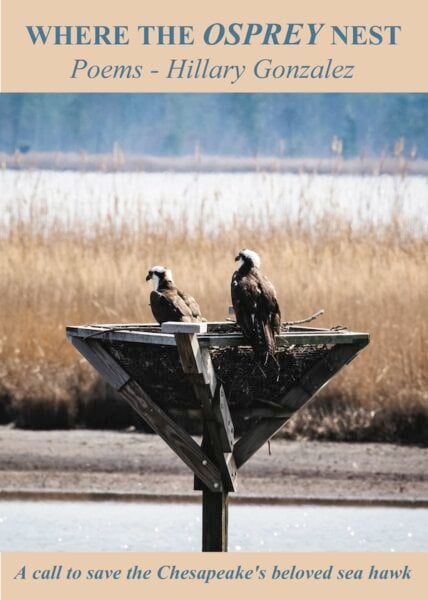
A call to save the Chesapeake Bay’s beloved sea hawks. Where the Osprey Nest is a poetic love letter to the natural world–and a rallying cry for its defense. Rooted in the principles of climate justice, this collection draws attention to the vanishing habitats of species like the osprey, whose populations along the Chesapeake Bay are in alarming decline. Gonzalez, a queer and AuDHD birder, writes with aching tenderness and sharp clarity about what we lose when we allow our ecosystems to collapse. Composed entirely outdoors–in forests, marshes, and along shorelines–the poems evoke deep kinship with wild spaces and the creatures who call them home. From meditations on ospreys and herons to reflections on grief, healing, and interdependence, Where the Osprey Nest asks readers to listen, to remember, and to act. These poems remind us that we are not separate from nature–we are nature, and if we are to survive, we must rise in defense of the living world.
Mississippi River Open School for Kinship and Social Exchange
Edited by Dio Cramer, John Kim, Jeremy Meckler, and Rebecca Snedeker
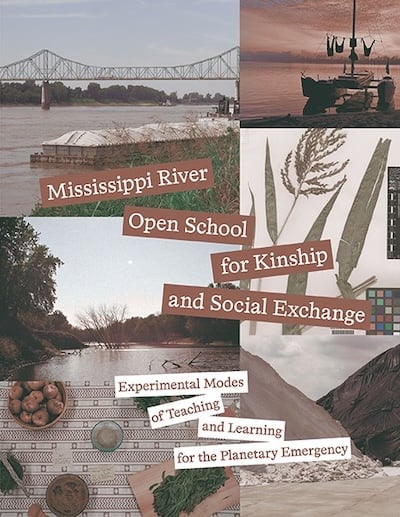
The Mississippi River Open School for Kinship and Social Exchange (2022–2025) is a structurally radical, community-engaged educational project that turns the university inside out to make it a home for public pedagogy, reconceiving the relationship between universities and frontline communities. This book collects, curates, and represents much of the work produced by, through, and in collaboration with the Open School. It foregrounds the central methodology of collaboratively imagining and practicing experimental modes of teaching and learning for the planetary climate emergency by drawing from a growing archive of creative writing, art, film, interviews, and activist toolkits, and it engages pressing issues of race, environment, and extraction as it connects crises experienced along the Mississippi River, from its headwaters to the gulf.
Contributors: Morgan Adamson, Jamie Allen, Kayla Anderson, Ida Aronson, Sara Black, Bruce Braun, Imani Jacqueline Brown, Nicholas Brown, Andrea Carlson, Aron Chang, Jennifer Colten, Morgan Piper Cordova, Amber Ginsburg, Tammy Greer, Shana M. Griffin, Ryan Griffis, Brian Holmes, Sarah Kanouse, Sarah Lewison, Jacob Lindgren, Stephanie Lindquist, Jason Ludwig, Jenna Mae, Shanai Matteson, Nelson Mondale, Tahani Nadim, Ozone 504, Sara Pajunen, Lynn Peemoeller, Claire Pentecost, Roopali Phadke, Zane Piontek, Catherine Russell, Kirisitina Sailiata, Meira Smit, Joe Underhill, Monique Verdin, Jesse Vogler, Colin Waters, Mark Williams, Jan Zalasiewicz.
Abolition and the Rise of US Environmentalism
By
By the 1840s, many Americans recognized that the institution of slavery was destroying Southern landscapes while threatening to expand into the West. An increasing number of white Northerners believed that surrounding areas where slavery was legal with so-called free soil would hasten its collapse and forestall an environmental crisis. James S. Finley addresses this understudied intersection of US antislavery and environmental politics in the two decades before the Civil War, arguing that the debate over free soil–what it should look like and who should have access to this land–was an underrecognized precursor of modern American environmentalist movements.
Through the work of a group of Black writers and thinkers, the Free-Soil movement’s white supremacist underpinnings were challenged by an ecosocial vision that centered democratic communities and sustainable labor. By analyzing the output of authors who advocated for truly free soil, such as Frederick Douglass and Henry Highland Garnet, Finley finds commonalities in their attempts to reenvision communal relations between individuals and the land with contemporary movements for racial and environmental justice.
My World is Melting: Living with Climate Change in Svalbard
By Line Nagell Ylvisåker
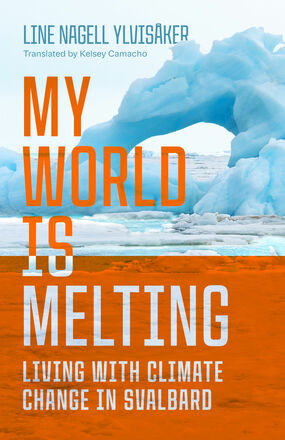
In 2015, in a tragic natural disaster, a massive avalanche descended on the small Arctic Norwegian city of Longyearbyen, Svalbard, leveling eleven houses and killing a child and a young father. In this arresting book, journalist Line Nagell Ylvisåker explores the effects of a warming planet up close and personal, from inside a remote community intimately attuned to its environment.
Ylvisåker introduces readers to her friends and neighbors, including dedicated meteorologists racing to anticipate future disasters and a veteran trapper who harbors doubts about climate change even as he bears witness to a constantly shifting landscape. Blending memoir, long-form journalism, and scientific reportage, she provides an intimate picture of life in a place where the effects of climate change can be seen in all their startling reality–and a compelling and hopeful argument for collective and cooperative action across the globe.

John is an award-winning author of stories, novels and plays. He is author of THE STANDING DEAD, coming in 2027. He is also author of the novels The Tourist Trail and Where Oceans Hide Their Dead and co-author of the mystery Devils Island. He is editor of Writing for Animals (also now a writing program). More at JohnYunker.com.