
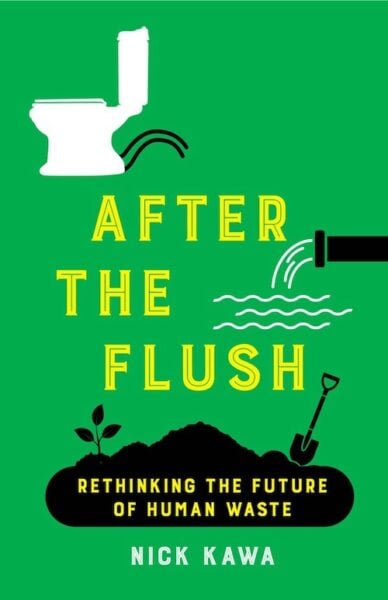
What happens after you flush?
In After the Flush: Rethinking the Future of Human Waste, author Nick Kawa takes us on an enlightening and at times frustrating journey from toilet to biosolid and beyond.
I wanted to read this book because I’ve long wondered, as Kawa writes: “… isn’t it fucking wild that hundreds of millions of people in North America shit into fresh drinking water on a daily basis?”
In a world where drinking water is in short supply why have we in the US (and elsewhere) developed a system that wastes so much of it? And why do we waste human waste as well? Human waste historically made excellent fertilizer and was used as such (a valuable commodity known as night soil) until the emergence of plumbing systems.
Fortunately, sewer utilities around the country are working to reuse conditioned human waste, branded “biosolids.” Biosolids make a cost-effective fertilizer and are widely used by farmers and on golf courses and even in upscale communities. But there are concerns about the other chemicals we consume and dispose of that also make it into these biosolids, like antibiotics, toothpaste chemicals, artificial sweeteners and so on. But most alarming are the 9,000 or so “forever chemicals” known as PFAS. In 2022 Maine banned the use of biosolids for just this reason. A growing number of people are not so confident that biosolids should be used on agriculture and, given the recent dismantling of the EPA, have less and less faith in the government for providing a regulated solution. And yet, as Kawa notes, these risks are often exceptionally low, particularly when one considers all the other risks we readily accept in our day to day lives. Still anything associated with human waste carries a level of cultural baggage that is hard to overcome.
But if biosolids aren’t the answer, Kawa points to more localized solutions. Just because you may not want to reuse community waste on your raised beds you might be willing to reuse your own waste.
We meet Joe Jenkins, author of the Humanure Handbook and evangelist for turning your personal waste into compost. While I’ve yet to try this at home I did experience a similar compost toilet in New Zealand and can report there was no smell — which is often the biggest fear about these toilets.
Kawa highlights a pilot project in Santa Clara with folks who lost septic systems due to wildfires or don’t have enough money to replace/fix their sewer systems. The organization GiveLove helps provide container-based toilets and have also done so in a number of countries. Here is what a ‘sasquat” looks like:
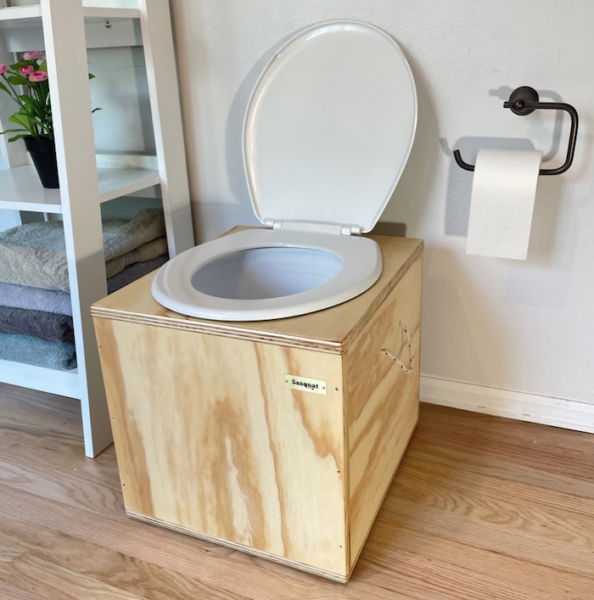
But as Kawa notes, container-based solutions can be a tough sell: “For those accustomed to the flush toilet, or who desire to possess one, the compost toilet can leave excreta too close for comfort.” The porcelain toilet is associated with modernity and anything less feels like a step in reverse.
And yet only 80% of Americans have access to sewers and 3.5 billion people around the world have no sewers. So clearly we need better solutions sooner than later. It’s a shame that we invest so much energy on worrying about what we put into our bodies and so little thought into what comes out, as Kawa writes:
What does it matter if everyone eats local, organically produced food if it all ends up as shit that gets flushed and bound up with endocrine-disrupting compounds and industrial contaminants that are directed down drains into sewers, resulting in a sludge product that can’t even be used in USDA-certified organic agriculture? The foodies’ obsession with pesticide-free, herbicide-free, chemical fertilizer-free food addresses only one part of the agroecological system.
How does one reengineer a sanitation system to use less fresh water? It’s not an easy question to answer. But perhaps individually we can work to reduce our water usage while re-using our waste and encouraging our communities to test out new ideas. For instance, in Vermont the Rich Earth Institute supports a “peecycling” project that both saves water and provides fertilizer for the region.
After the Flush is an important and fascinating book and will get you rethinking your waste.

John is an award-winning author of stories, novels and plays. He is author of THE STANDING DEAD, coming in 2027. He is also author of the novels The Tourist Trail and Where Oceans Hide Their Dead and co-author of the mystery Devils Island. He is editor of Writing for Animals (also now a writing program). More at JohnYunker.com.