
When I first started reading Where the Earth Meets the Sky: Penguins, People and Place in Antarctica by Louise K. Blight, which was published in April of this year, all I could think of was how much I wished I’d had this book in my hands when I was researching My Last Continent. Blight, a conservation biologist and adjunct professor at the University of Victoria’s School of Environmental Studies, lived an Antarctic life so much like the one of my fictional Deb Gardner: “short stints aboard luxury cruise ships, where my roles included naturalist, Zodiac driver, and visiting scientist … [and where] the comfort and safety of the passengers was always the focus of those trips; science took a back seat.” Also like Deb, Blight spent a summer at McMurdo Station, where her memoir takes place.
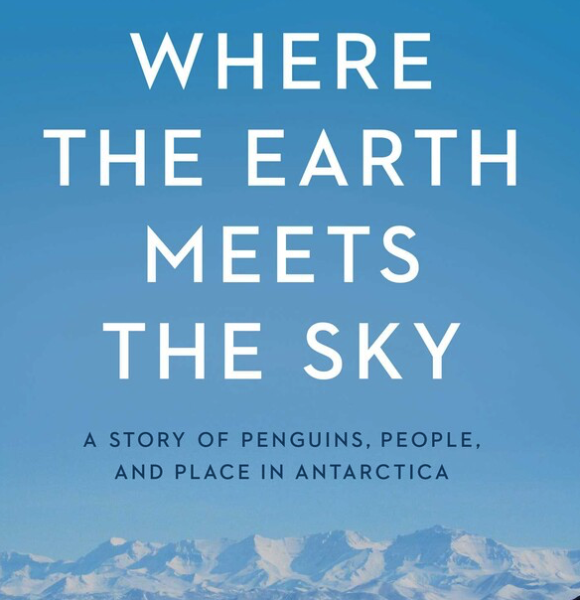
Blight’s observations of and reverence for the penguins felt so much like Deb’s, as well as her acknowledgement that “humanity has been altering Antarctica since the ships of sealers and whalers first plied its icebound waters. What has changed so suddenly is the scope and the reach of human impact. This is a story of an Antarctica on the cusp of that change.”
My Last Continent, of course, is fiction about Antarctica on the cusp of change (and, being fiction, it also has a love story and a shipwreck) — and Blight’s nonfiction book is far more scientific and historical but no less emotional; in addition to being drawn to science and animals, she writes that, after her sister’s and father’s deaths, “I was also drawn to Antarctica’s indifference … I craved a place where human suffering felt insignificant.” Where the Earth Meets the Sky is a thoughtful, contemplative read for Antarctica and penguin geeks as well as for anyone who loves remote places.
Until her three-month stay on Ross Island, Blight had, like Deb, “worked on board as a naturalist or visiting scientist, battling seasickness while giving lectures on whales, penguins, and climate change, and censusing the seals and seabirds at the sites we visited along the Antarctic Peninsula, that skinny handle-shaped protuberance that stretches up to South America from the Antarctic continent proper.” Now, Blight would be in a location “remote even by Antarctic standards and one that would be blissfully free of humans” — which was always Deb’s dream as well.
Blight’s visit and research took place in the summer of 2003, near the Adélie penguin colony at Cape Royds, alongside another scientist, David Ainley, where they studied how the area’s Adélies were affected by iceberg B-15, wedged against Ross Island and impacting ice-flow patterns and penguin breeding. Blight writes, when they arrive at their field camp near the Adélie penguin colony, “Cape Royds is bleak and stark under a grey sky … a moonscape with penguins.”
Blight’s vivid details give readers the sense of being on the continent, from the beauty of the landscape to the descriptions of those who live and work at McMurdo (or “Mactown” or just “town”), the long-timers being easily distinguishable from “a fingee—an FNG or fucking new guy.” On her first tour, Blight found that the station had “everything from cross-country skis and board games to high heels, feather boas, and penguin costumes” — as well as two bank machines, a rugby pitch, a coffee house and wine bar, two additional bars, a computer lab, science labs, a bouldering gym, and a library.
While deftly putting readers in the moment, Blight also writes with hindsight, about both the state of the continent and her own emotional journey. “In the numb aftermath of my sister’s death, I had settled for too many things: a mediocre job as a biologist in government, from which I’m currently on leave; a master’s degree in Canada rather than a PhD program in Australia, where I’d been headed to do doctoral research on marine birds until my sister was diagnosed with cancer; and a relationship with a man with anger management problems. I’ve left this future ex-husband behind at home, and I realize that I don’t miss him at all.”
Blight covers the history of science and exploration on the continent, but perhaps most fascinating are the little things that show how challenging working on the continent was and still is: “It’s so cold and dry here that my fingernails keep breaking at the slightest stress. I catch one on my parka and it snaps off down below the quick, so I find a roll of duct tape … and wrap some around my finger to avoid snagging the nail again and tearing half of it off.”
Blight compares details about being a researcher out on the ice — the food, the camping, the sheer amount of clothing that must be worn and the number of calories that must be consumed, and the emotional toll of the conditions and isolation — with the expeditions of explorers like Shackleton and Ross a century before; a lot has changed, but surprisingly a lot has stayed the same. Even in the Antarctic summer, temperatures hover around -20 degrees Celsius, and sudden weather extremes are common. Blight recalls a story about a woman who got trapped in an outhouse when a whiteout whipped up during the short time she was in it. “In Antarctica, better a couple of hours huddled in a wind-free shitter than wandering off and dying in the attempt to make it back to the relative comfort of the cookhouse.”
Amid violent storms and dangerous cold — and the effects of constant daylight on one’s body and mood — lovely moments make the challenging ones worthwhile: “At midnight I sit on the deck sipping a whisky before turning in. The world is ethereal, breathtaking, pure, and crystalline, sun glinting on fresh snow, the silence simultaneously piercing and remote.”
And, of course, there are the penguins, many of them unafraid of the scientists as they waddle and toboggan across the ice. “When I sit on the ice nearby to take a couple of photos I begin with my telephoto lens, but in short order have to switch to a 35mm and then to the wide-angle zoom as the curious birds come closer and closer.”
Yet while the colony is “full of pairing and mating, hatching and growth, life force in full swing,” Blight also writes about the harshness of nature: “All of life is on display here. Mates desert each other, eggs and chicks are taken by skuas … offspring are deserted by parents and starve. Even adult penguins … occasionally stagger into the colony with sprained limbs or grievous bodily wounds.” Yet penguins are survivors, and Blight’s story of one badly injured penguin making it through the season is a testament to their endurance.
After three months on the ice, Blight finds the peace she’d been seeking but also finds herself ready to leave: “I love it here but it can’t go on forever, and neither would I want it to. My fingernails are chronically dirty, my skin is breaking out from the infrequent washing, and my hair needs a cut. I’m getting tired of smelling like penguin and eating frozen and dehydrated foods.”
Yet thanks to her time on the ice, she — like so many others who have visited or lived in Antarctica — returns home changed. “Then it will be back to The Other World, The Real World, The World, as it is variously known here. Back to the petty obligations of mowing the lawn, washing the car, paying the bills for the things we don’t really need. Back to banks and blacktop, to darkness and door locks, to politicians and to war … It’s not just the incredible beauty of Antarctica that people miss when they leave. It’s being somewhere that shows us what the world could be, a saner and more peaceable place.”
Midge Raymond is a co-founder of Ashland Creek Press. She is the author of the novels Floreana and My Last Continent, the award-winning short story collection Forgetting English, and, with John Yunker, the suspense novel Devils Island.