
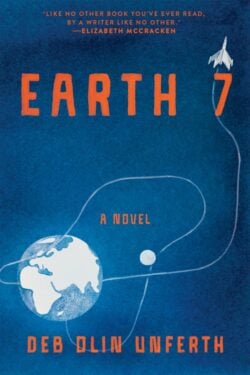
The population of Earth is decreasing, and Rosemary and her daughter escape the increasingly inhospitable conditions on land (radiation, disease) to live in an underwater pod. At least that’s what others assume. In fact, it’s because “she was sick of people.” So begins Deb Olin Unferth’s Earth 7, a compelling, dystopian, sci-fi tale about environmental collapse, humanity’s struggle to survive, and an unlikely romance. It is also a disturbing vision of people’s increasing estrangement from nature and one another.
The specific causes behind Earth’s environmental downfall are never fully explained––“the entire human mess” sums it up sufficiently––but we discover something of survivors’ new realities. Some retreat to undersea pods, which is where “the child,” who later names herself Dylan, grows up with her eccentric scientist mother. Others colonize Mars. Dylan later meets one of their descendants, Zee. Virtually at first, then in person when on her deathbed. Others yet, like Melanie, the hybrid human-plastic woman Dylan loves, are in between, on terra firma, where survivors, at best, experience nature in simulation: “nothing around Melanie was real––not the waves she was watching, not the muscles in her face, not the blue in the sky, which had a filmed hue projected onto it to mask the sulfur, not even the horizon, which was enhanced and colored.”
As nature collapses, there are feeble attempts to fill the void with technology and reminders of the dehumanizing impact of a hyper-tech’d existence are there from the outset: Rosemary’s under socialized child (her mother “refused all invitations”); Rosemary continuously at her computer (“opened all her files at once”); Rosemary wondering why her daughter “couldn’t … stare at her screen like a normal person.” In a loose parallel with Unferth’s earlier novel, Barn 8 (2020), in which animal activists recoil at factory farming that reduces hens to machinery, Earth 7 has the mother and the as-yet-unnamed child (I can’t help think of Ira Levin’s 1967 horror novel Rosemary’s Baby as I type that, though the horror here is not supernatural) in an environment “less and less human.”
The ‘geography’ of the story, with some at the bottom of the ocean floor, others in outer space, has the effect of highlighting the missing middle, (Middle?) Earth, land, the proper domain for people and other mammalian animals. “‘I can’t just live here [under the sea] forever,’” Dylan tells her mother. “‘I can’t never see Earth again.’” The effect is disturbing, forcing an imaginative gaze at the Anthropocene, a nightmare of a lost world. This disconnection terrifies Dylan, her unnatural underwater childhood existence likened to insects trapped under a glass bowl, saved but suffering.
Occasional similarities between Earth 7 and Barn 8, not least the shared alphanumeric title format, invite consideration of shared themes. Both, though in very different ways, explore the troubling disconnect between humanity and nature. There are also various shared terms and names: Dylan, a minor character in Barn 8, a principal in Earth 7; Dill, a major character in Barn 8, sounds like Dell, aka, Teresa, a minor in Earth 7;“Depop,” referring to the removal and slaughter of spent layer hens in the one, and the collapsing human population in the other; Gallus gallus, ancestor of the domestic chicken, mentioned in both. More subtly, Janey in Barn 8 thinks the massive factory farm barns she sees are “sci-fi–level crazy,” and Earth 7 is indeed just that .… I mean that as a compliment. In the earlier book, the principal female character Janey marries Zee. In the latter, Dylan communicates with the Martian-born Zee when young and then entrusts her life’s work to him just before she dies.
Though it presents a terrifying post-apocalyptic, post-eco-collapse vision of humanity’s fate, Earth 7 is simultaneously hopeful. There is something beautiful about Rosemary’s child waiting at the windows of their underwater pod day and night, staring at the dead ocean, because “she didn’t want to miss the fish when they came,” and then remaining there even “when it was clear no fish were coming.” Her longing for connection with nature persists. We see it again in her later fascination with tardigrades, among the simplest forms of life, preserved in sand. There’s something vaguely reminiscent of Barn 8 here too, with eccentrics like Janey and Cleveland, Dill and Annabelle scheming to steal a million chickens from an egg farm. It’s an insane plan, yes, but humanity’s capacity to imagine something better, whether extinct fish returning to dead oceans or a world without factory farms is where optimism and the impetus for activism lies.
We also see Dylan’s instinctual longing for nature when she first leaves the pod to live on land. Her mother arranges an internship at the lab where she works. This is entirely unsatisfying but after a series of meaningless assignments, Dylan formally becomes, fittingly, the institution’s “groundskeeper.” Nature, earth, the Earth, her fascination with sand and tardigrades, offers some semblance of normalcy.
If connection with nature is needed for flourishing, so too is love and meaningful interactions with other people. Dylan is antisocial when she leaves the ocean but eventually falls in love with the badly damaged Melanie, the product of extreme plastic surgery, reality tv, and mad science. So many were the manipulations to her body, she was in a sense, “a robot, or being turned into one, cell by cell.” That Dylan loves the human-but-plastic-and-sort-of-robotic Melanie reflects the ever-increasing encroachment of technology on the emotional lives of people. Furthermore, Dylan’s longing for a relationship with the orbiting Zee, that descendant of Mars colonizers, is at first frustratingly virtual (“He’d probably been an AI all along”).
Dylan’s scientist mother and the research laboratory where she works is engaged in the “great project,” the so-called “preservation project: selecting animals, or rather subanimals, or their molecular representatives (DNA), and inserting them into cages, where they’d remain for all time.” Those involved planned for every contingency—asteroid strike, nuclear war, flood, fire—to ensure “‘there would be more Earth somewhere, at least a little bit’” (italics original). Various collections of flora and fauna DNA are hidden all over the world or shot out into the sky in hopes of preservation in some form. These collections are dubbed Earths 2, 3, 4, 5, 6. Dylan finds this concept of Earth-saving through molecular collections, the attempt to create an ersatz world, “absurd.” Much later Zee reaches the same conclusion: “Out of this mission, because of him, the Martians of human descent could re-create the home planet…. But even as he thought it, he knew it would never happen…. It was impossible.”
Is there room for optimism? I close noting the suggestive phrase “on the third day,” which appears three times in the novel. It is, of course, evocative of resurrection, of life after death, but in this context has no religious connotations. Twice it appears while Dylan is in the desert, reflecting on sand, “made up of the rock that formed before the beginning of life.” During the third day of those meditations, she realizes the sand “was alive, had agency, was already constructing the next Earth,” was rising from ecological death. The term repeats. On that third day she has an urge to “follow her thoughts,” which culminate in a revelation: “She could see it, Earth 7.” This is the first mention of Earth 7. Earths 2 through 6, as noted, are the scientific efforts to preserve life, the “molecular collections,” the “DNA,” the instructions needed “to make your own goat,” and so on, all of which seems ridiculous to Dylan (the folly of it all is illustrated humorously in the closing pages). She begins constructing Earth 7, which is very different in approach. She explains to Melanie that sand contains life, referring to the tun tardigrades that so fascinate her: “Her idea was to take a precious strand of DNA from the lab, enclose it in a molecular cuticle, implant it in a tardigrade, let the organism dry out, move into tun,” thus constructing a molecular collection that needs only dry sand. When the lab where she works explodes, Earth 6 does not survive, but Earth 7, secretly hidden by Dylan and Melanie, does, later to be taken to Mars by Zee. But even that proves unnecessary. Earth would preserve itself, even without humanity’s intervention: “There was no need of Earth 7 at all.” The evolutionary processes continue. Mention of the “third day” at these key points in the story suggests rebirth and preservation of the damaged world is not to be found in divine intervention, as that term usually signifies, or scientific ingenuity. Earth itself, the sand, provides the needed resurrection.
This is a wonderful book. Twists at every turn of the page as unpredictable as the next. It also includes sobering warnings, and perhaps these are predictable: the fragility of Earth’s marvels; the destructiveness of humanity’s appetites; its hubris and misplaced trust in science and technology. What is needed, instead, is love for Earth, and for all forms of life sharing it with us.
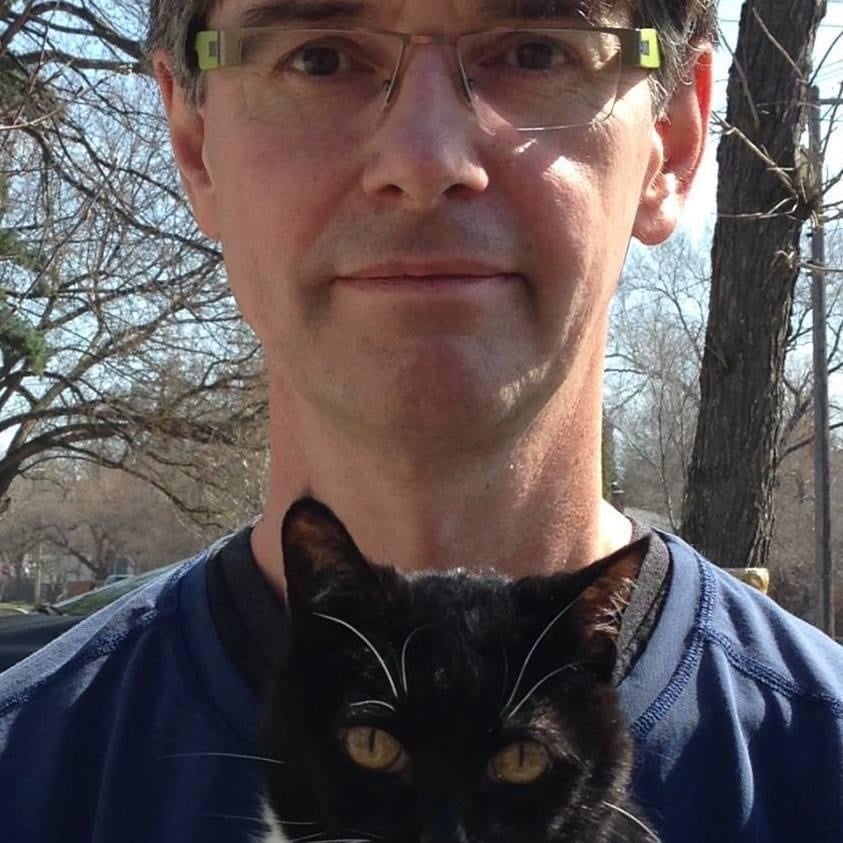
Michael Gilmour teaches English literature and Christian theology, and much of his writing focuses on ways these disciplines engage animal ethics. His books include Eden’s Other Residents: The Bible and Animals, Creative Compassion, Literature and Animal Welfare, and Reading the Margins: Encounters with the Bible in Fiction.