
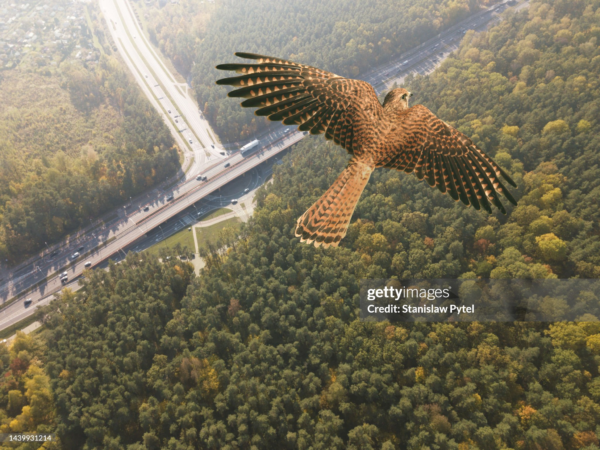
While driving down the East Coast on a recent road trip, I found myself mesmerized by the many hawks I saw overhead as I traversed the highways. Appearing to glide more than fly, these majestic creatures soared through the skies without beating their wings for what seemed like minutes at a time.
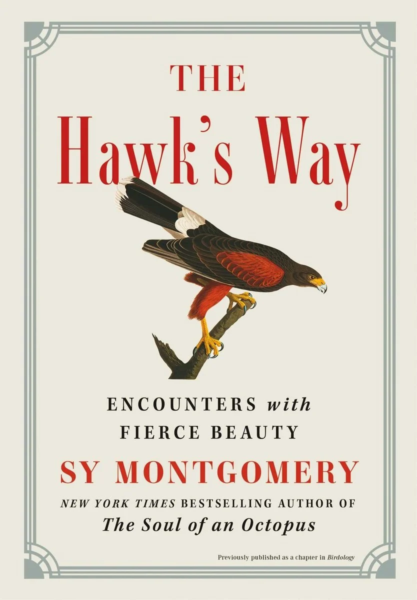
As I drove on, continuing to watch them, I found myself wanting to learn more about these birds of prey. I already knew a good deal about what I think of as “backyard birds”—jays, crows, sparrows, robins—but hawks, and raptors more broadly, were more of a mystery to me. Enter Sy Montgomery’s thought-provoking and informative little book The Hawk’s Way: Encounters with Fierce Beauty, which I decided to start listening to right then and there as I drove down the highway. In it, Montgomery offers readers lots of delightful details about hawks, raptors, and the history of falconry.
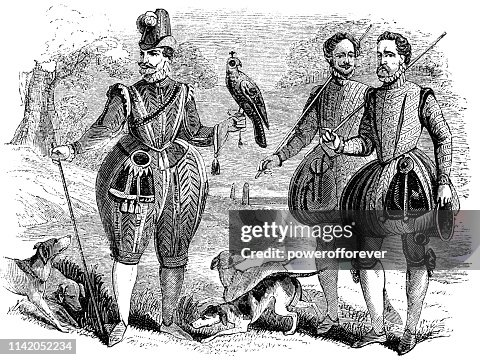
This brief non-fiction book focuses primarily on the author’s time training and “apprenticing” with a friend and experienced falconer. As the narrative unfolds, we also learn about the history of falconry more broadly–a human-animal partnership that pre-dates Roman civilization by thousands of years, having roots in ancient Egypt, India, Persia, and China. Described as both an art and a sport, falconry involves training birds of prey to hunt in cooperation with a human (and, in some cases, in a trio that also includes a hunting dog). Although falconers develop a close relationship with these raptors, often working alongside the same bird for years or even decades, Montgomery stresses that falconers do not own these birds and that the birds are not pets. Instead, she repeatedly reiterates, this is a partnership in which the hawk is the lead partner, and the falconer a sort of assistant or second-in-command.
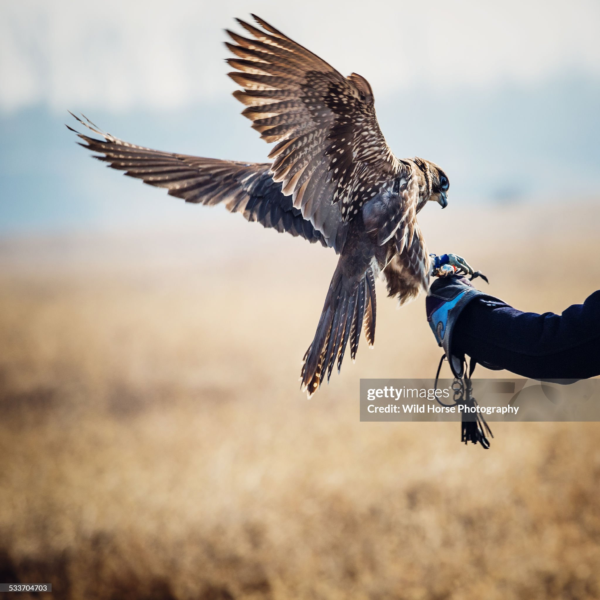
her partner’s gloved hand
This emphasis on the hawk as a partner–the lead partner–and not a pet encourages the reader to rethink humans’ relationships with animals, especially those we domesticate or keep as pets. I was struck, for example, by the fact that serious injuries, including permanent damage to the eyes, face, and hands, are a common risk for falconers working with birds of prey: the likelihood that a hawk might injure its human partner, whether intentionally or unintentionally, is both expected and accepted as part of what falconers call “yarak”: the bird’s innate wildness and the instinctual behaviors that accompany this. In contrast to animals we regularly domesticate and keep as pets–dogs, cats, pigs, parrots–the hawk is not expected to adapt to the human’s world or to the expectations of an “owner.” It is certainly not expected to be tame or obedient. Its wildness, its ferocity, even its ability to harm humans, are all accepted by the falconer as part of the animal’s nature, without this precluding the possibility of human-animal partnership.
Despite the admirable respect that falconers have for the “yarak” or wildness of the raptors they partner with, Montgomery’s book nonetheless raises questions about the ethics of falconry. In ancient times, falconers used these hunting partnerships to survive, but in the US today, few of us need to hunt alongside a bird to feed ourselves or our families, and indeed, many humans opt not to eat meat at all. However, Montgomery notes that for those who do eat meat, obtaining it by hunting is a far more humane, compassionate, and ecologically friendly approach than factory farming, which she describes as both “hideously cruel” and “ecologically disastrous.” Falconry also acts as a form of conservationism for birds of prey, many of which are threatened or endangered: while hawks typically live only up to seven or eight years in the wild, with many juvenile hawks dying in their first year, they can live up to thirty years with the support of a falconer’s care.
Nonetheless, the question of what purposes falconry serves–and should serve—in the US today remained largely unanswered for me by the end of the book: are today’s falconers engaging in falconry to hunt for food? To hunt for sport? As an act of conservationism? Or is falconry merely a hobby that gives humans enjoyment at the expense of certain animals? The woman who trains Montgomery in falconry notes that “folks are drawn to falconry for all sorts of wrong reasons”; Montgomery herself admits that “from falconry I want only one thing: to get closer to birds of prey.” Though I can understand Montgomery’s desire to be close to and better understand these fascinating, powerful animals, parts of her story made me uncomfortable: her visit to a hunting grounds where smaller birds like quail are bred specifically to be hunted, or her use of a “quail launcher” (which is exactly what it sounds like) to train hawks and hunting dogs.
Montgomery, too, admits that she is deeply uncomfortable with some of what she participates in as a falconer’s apprentice. Throughout the book, she questions her own motives as well as the ethics of falconry, while also exploring her attraction to and interest in this “ancient art” in thoughtful, exploratory ways. Readers will have to decide for themselves what they feel about this human-animal partnership and its uses and applications in our contemporary world, but Montgomery leaves us with much food for thought by the end of her brief book.
A renowned naturalist and author who has also researched and written books on octopuses, pigs, chickens, hummingbirds, turtles, and other animals, Montgomery writes in her signature style throughout The Hawk’s Way: a joyful, passionate narrative mixes accessible science with memoir and personal experiences. One of my favorite nature writers, I look forward to seeing what animals Montgomery communes with and writes about next.

Melissa Dennihy, Ph.D., is a Professor of English at the City University of New York, where her work focuses in part on eco-literature and environmental humanities. She is the recent recipient of a grant to support her integration of sustainability curriculum into humanities courses for community college students. She lives in New York with her dog, Pearl, a rescue from Puerto Rico.