
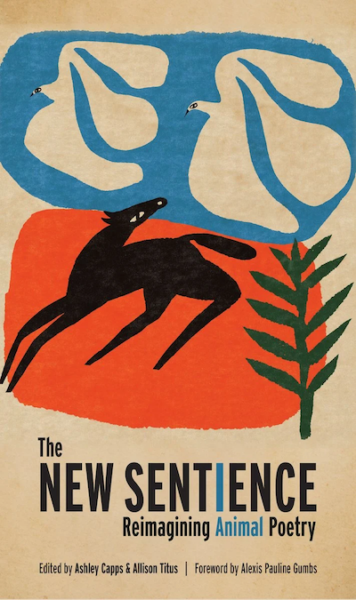
The New Sentience: Reimagining Animal Poetry is poetry collection a long time in the making: Ten years according to editors Ashley Capps and Allison Titus.
The wait was worth it. For what readers will find in this collection are some of the most thought-provoking, creative, compassionate and courageous animal poetry from the past hundred years.
I was already familiar with a number of the poets included here, such as Gretchen Primack. Here is an excerpt from her poem Love This:
Her breast milk is banked for others. Her son
is pulled away to lie in his box.
He will be packed for slaughter. How ingenious
we are! To make product from byproduct:
make use of the child,
kill and pack and truck him to plates.
And Nickole Brown with an excerpt from The Donkey Elegies:
Who can say if Adam understood the consequences of his task, but each
word we give to name an animal is a sentence, a decision made by the court tribunal that is us:the difference between a dog and cur, cow and stock, between deer and game,
possum and vermin, mouse and feeder isThe difference between a wheel to run on versus a glue trap, a copper cowbell or a stockyard-style knocker of electricity meant to stun before the blood is drained.
Now, call a donkey a jackass and you make the animal into a classic punch-
line of the kingdom…
But I discovered many other poets who dare to say the unsayable: That animals don’t deserve to be be slaughtered, to be mistreated, to be artificially slotted into some hierarchy of value created by humans.
Holly Amos in Between Eating & Feeding, a damning account of foie gras production:
The people
wear gloves on their hands. They don’t want it
on their hands. That which is being pushedinto the ducks.
Tytti Heikkinen writes about the chicken in I’m a Broiler:
since no taxonomy
would recognize us as an independent species
and that’s good, since even though
59,794,239,000 of us are killed per annum
we aren’t threatened by extinction
or genocide
or murder
because we don’t exist
Other amazing poets in this collection include Ashley Capps, CAConrad, Aracelis Girmay, Tytti Heikkinen, Hiromi Itō, Lêdo Ivo, Fady Joudah, Tao Lin, Pattiann Rogers, Alberto Ríos, Brayan Salinas, Zachary Schomburg, Abraham Smith, Gerald Stern and Allison Titus.
Animals range from horses, cows and chickens to moles, foxes, opossum and beetles.
In a collection this ambitious, I did feel that some poems were more “animal adjacent” and didn’t live up to the promise of reimagining. Some poems also referred to animals as “it” which stood out in a collection of so many progressive and empathetic poems.
That said, I can’t recommend this collection enough.
That this book exists is a positive sign that the world is awakening, truly awakening to animals. And I hope it not only inspires more poets to embrace a future of writing about animals as equals (or our betters), I hope it inspires a new generation of readers to demand more from writers. As you will see in this collection, the future of animal poetry is bright.

John is an award-winning author of stories, novels and plays. He is author of THE STANDING DEAD, coming in 2027. He is also author of the novels The Tourist Trail and Where Oceans Hide Their Dead and co-author of the mystery Devils Island. He is editor of Writing for Animals (also now a writing program). More at JohnYunker.com.