
As we’ve covered before, there are so many scams out there targeting writers, and it’s only getting worse. Now scammers are posing as editors, using very realistic emails to lure writers into responding with the hope of establishing a relationship with a top editor.
Here’s an email I recently received:
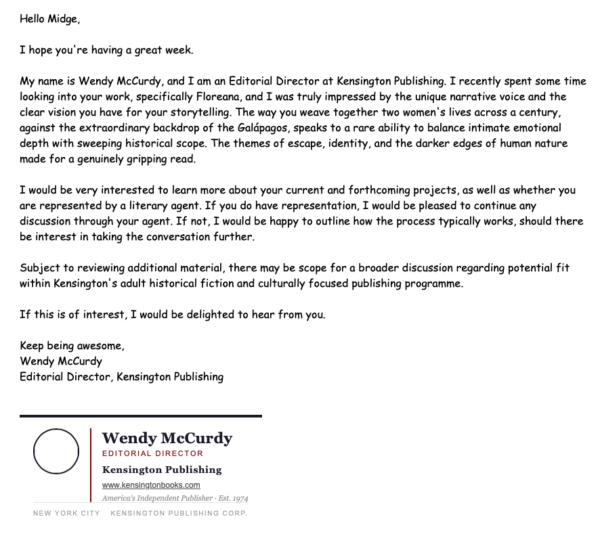
This is scary on many levels, the first of which is that Wendy McCurdy is a real person, and she actually is Editorial Director at Kensington. And this email, unlike the very obvious poorly written fakes, is quite polished (though definitely a bit on the overly formal side … until the “Keep being awesome” closing).
Of course, “Wendy’s” kind words about Floreana (thanks to AI) are alluring — this is usually what makes these emails so hard to resist — and the fact that “Wendy” would like to talk to either me or my agent makes her seem accessible and professional.
Other than knowing that the real Wendy McCurdy would never send a random email like this, I noticed one red flag straight away: the British-English spelling of “programme,” which an American editor would never use.
And, as always, writers (and everyone who gets random emails, for that matter) should check the sender’s email address — in this case, though the email appeared in my inbox to have come from “Wendy McCurdy,” a look at the email address revealed that it was, in fact, from wendymccurdy.kensington@aol.com. (If you visit the Kensington website, you’ll see that legitimate emails will come from accounts at kensingtonbooks.com — not a random AOL account.)
What’s crazy is that I can remember, decades ago, when editors and agents genuinely did reach out like this: Over the years (and this was many years ago!) I received emails from agents who’d read a short story of mine in a print magazine and wanted to chat about when I was going to write a novel. I had conversations and lunches and relationships with agents who’d contacted me in this very same way … only it was real. Some of you writers of a certain age may remember these days, too.
But, sadly, those days are long gone — and we writers all have to know that this isn’t how it works anymore.
Remember: If it seems too good to be true, it usually is.
Remember: Always check the actual email address, and never reply directly; if you’re convinced it may be real, find the editor/agent/whoever via their real website and reach out that way. (Often just by visiting the website in question you’ll see a warning about these scams.)
And remember: Never give up on finding a legitimate agent or editor to fall in love with your work. Just be sure it is someone you reach out to, not the other way around.

Midge Raymond is a co-founder of Ashland Creek Press. She is the author of the novels Floreana and My Last Continent, the award-winning short story collection Forgetting English, and, with John Yunker, the suspense novel Devils Island.