
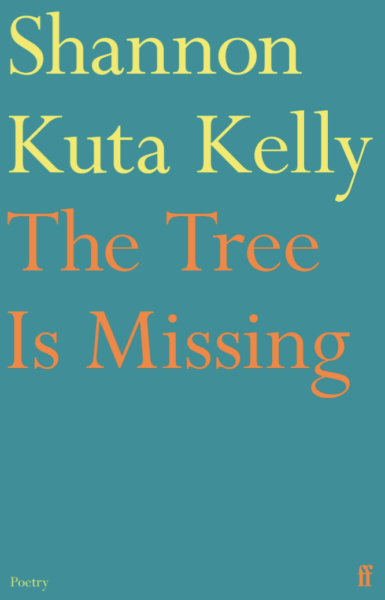
Shannon Kuta Kelly’s debut poetry collection The Tree is Missing is a reflective and emotive meditation on humanity’s inseparable relationship with the natural world. It presents a range of lyric poetry highlighting themes like nature in city settings, mythical imagination and human interaction with the environment. Kuta Kelly evokes a supernatural element throughout the work, blurring the boundary between the human and nonhuman, as she explores a range of urban and rural spaces.
The collection is structured in two distinct sections, shifting in tone and perspective while retaining a focus on the environment throughout. Section one focuses largely on realism with nature positioned as a peaceful backdrop against human experience, often relaxing urban landscapes. In poems such as “What I Return to Each Time it Rains,” moments of natural beauty emerge somewhat unexpectedly in the city:
My guests are surprised by the sweetness of the raspberries
growing in the lilac-flush parks.
In that city my dreams are vivid and perfect.
The swans on the lake by the castle
come in as many colours as you can imagine.
Here, it is clear that nature persists within the city environment, although it is backgrounded, offering comfort and beauty to the speaker. This poem was my favourite of the collection, with the dreamlike colour imagery of ‘raspberries’, ‘lilac’ and ‘swans’. In contrast, the second section leans more into folklore and myth, where the natural world is assigned a more active and dominant role. Recurring motifs, like The Tale of the Three Sisters and the imagery surrounding the ‘Big House’, suggest a landscape shaped not only by human presence but also by supernatural forces. In these poems, nature is no longer a passive backdrop but a powerful and often uncanny presence, capable of influencing and reflecting human emotion. This sectioning demonstrates the difference between Kuta Kelly’s presentations of the urban and rural.
Gardening emerges as a significant theme across both sections, presenting an everyday connection between the speaker and the natural world. For example, the use of newspaper to garden with in “Ballymena” highlights the tactile and reciprocal relationship between humanity and nature. Nature is shown to be something which is cultivated, lived with, and depended upon by humans. Alongside highlighting humanity’s close relationship with nature, Kuta Kelly frequently blurs the boundary between the human and nonhuman.
A sunflower stands
with its shaggy leaves outstretched,
so tall and alone I mistake it for a man.
In “Flower Dream Sequence,” the image of a sunflower being mistaken for man suggests the power and equality afforded to nature. This suggests not only a visual similarity between human and plant life but also an equality of presence. Similarly, in “Dead End,” the absence of the tree becomes an important and poignant symbol of loss and disconnection. Through this, humanity’s relationship with nature is suggested to be a significant one. The search for the missing tree and the “initials carved into its trunk” echoes a deeper longing for continuity, memory, and belonging:
When you go back to the square, the tree is missing.
You have a photograph of yourself hugging the tree.
You spend a winter trying to find the tree, trying to find the
initials carved into its trunk.
The Tree is Missing is a reflective and personal collection in which nature is valued. Although it is not always foregrounded, natural imagery pervades across the collection in different ways. Across the collection, natural imagery permeates the poetry in varied and meaningful ways: as one with humanity, as something to be admired and as something elevated to mythical or supernatural significance. Kuta Kelly’s poetry ultimately suggests that human existence cannot be separated from the natural world, they are tied together through memory, storytelling and a shared planet. Overall, The Tree is Missing is a compelling debut that invites readers to reconsider the boundaries between the human and more than human world.

Jess Hill is a postgraduate student at the University of Durham. She is an English tutor interested in the environmental humanities who enjoys travelling, nature photography and camping.