
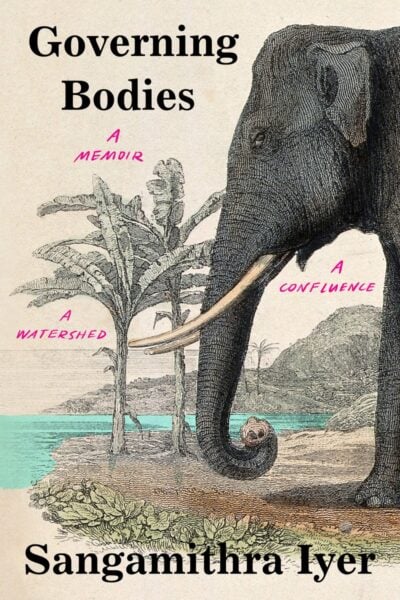
Sangamithra Iyer’s lovely, inspiring memoir, Governing Bodies: A Memoir, A Confluence, A Watershed, is told in three parts: in letters to her grandfather, to her late father, and to her readers. All three sections are intricately connected through bodies—of humans, of animals, of water—and how they converge, mingling past and present and flowing forward into an unknown future.
Iyer reveals the history of her family in a society “teeming with oppression, both from colonialism and the caste system”—from her grandfather, a civil engineer turned water diviner and activist, “part of a call to action to develop wells for communities who were denied access to water because cruelty deems them untouchable”; to her father, a social worker and poet who, in the early 1970s with only seventy-five cents in his pocket, arrived in the U.S. where he then “teaches yoga to hippies”; to her own life as an engineer, writer, and activist.
These intimate letters come together to tell the story of three generations finding their way as activists and, along the way, making indelible impressions on the worlds they inhabit. Iyer’s journey into the history of her family reveals the foundation of the intellectual and emotional curiosity she inherits, as well the ethical lens through which she views her own life, from her work as an engineer (“How can we be better, safer?”) to her volunteer work with animals (she learned American Sign Language to volunteer with Washoe and other chimps at the Chimpanzee and Human Communication Institute in Washington, and she learned French to communicate with chimps she volunteered with in Cameroon) to her research into history and place (she studied Tamil, dowsing, and cotton spinning to fully immerse herself in her research and writing).
Iyer’s observations about her family’s lives as well as her own cultivate and encourage empathy; she writes of navigating school as a child who was teased for her name (“children’s name teasing conveys a legacy of cruelty, an inheritance of fear of other, and a country that has not reckoned with its violent past, a land built on sorrow”) and also as a vegan (“not eating animals is one thing I am sure of even if it alienates me further from my peers”). Inspired by her grandfather (who, himself inspired by Gandhi, resigned from his job and shifted “from engineer to activist, from civil servant to freedom fighter, from subject to rebel”) as well as her father, Iyer quits her engineering day job to write for Satya magazine, where—with its focus on animal rights and social justice—a day’s work might include a chicken rescue. As Iyer continues her journey as a writer, she finds that “we live in a society where the torture and destruction of animals on a mass scale is so normalized that those who choose to question it are ridiculed.” Though she is often reluctant to make a scene when faced with such ridicule, ultimately she realizes: “Perhaps the scene I have to make is on the page.”
At the beginning of the third section of the book, Iyer writes, “If you haven’t realized it yet, this is a love story.” This is indeed a love story, one that spans not only generations, species, and geography but life-changing ideas. In addition to telling the stories of bodies—colonized bodies, living and nonliving and cremated bodies, grieving bodies—Iyer also tells stories of bridges, from her search for a Burmese bridge built by her grandfather to those bridges connecting species.
One unforgettable anecdote from the first section resonates through to the last page, as Iyer recalls a time during her volunteer work with the chimpanzee Washoe: “Washoe suffers multiple losses of her biological babies. Later, one of her human caregivers, a graduate student who is pregnant, would often sign with Washoe about the baby in her belly. The woman, however, suffers a pregnancy loss. When she sees Washoe again after some time, Washoe is curious why this grad student has been away so long. The caregiver decides to tell Washoe the truth, and signs to her MY BABY DIED. Washoe replies with a finger to the eye—CRY—followed later by PLEASE PERSON HUG. Chimpanzees recognize loss across species. This, too, is a bridge.”
Lovingly researched and beautifully written, with wit, compassion, and reverence for animals and our environments, Governing Bodies is a riveting and inspiring book for anyone who hopes to connect more deeply with the world we share with so many other beings.

Midge Raymond is a co-founder of Ashland Creek Press. She is the author of the novels Floreana and My Last Continent, the award-winning short story collection Forgetting English, and, with John Yunker, the suspense novel Devils Island.