
A Mosaic Novel of Family Ties, Climate Upheaval, and Resilience, By Ellen Meeropol
Sea Crow Press[1], March 2026
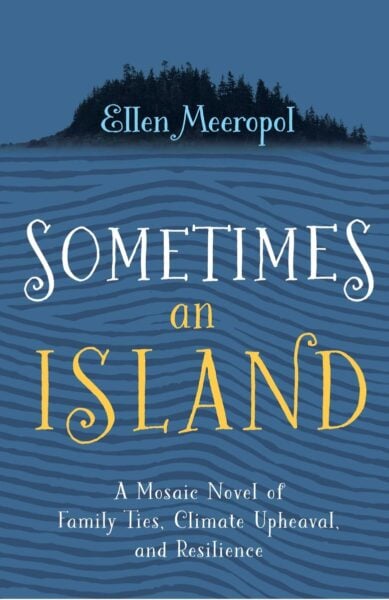
Sometimes An Island, a novel-in-stories by Ellen Meeropol, is set in the past, present, and future, “a long line of ghosts marching across the ocean from a shtetl in Eastern Europe, connected by blood and DNA and scar tissue.” Merging multi-generational voices into a cohesive whole is no easy task, but Meeropol, the author of a number of social justice and environmental novels, pulls it off. Sometimes An Island reaches back to the early 1900s pogroms in Russia, but most of the action concerns present-day climate refugees in Massachusetts and Maine, then continues slightly into the future, sometime after the Great Undoing of 2029. (There is a handy family tree in the front matter, and it helps.) The advantage of a novel-in-stories, or a mosaic novel, as it calls itself, is that it gives the reader a big picture of an even bigger subject, in this case, human migration in the name of survival. An island off the coast of Maine is the touchstone for this extended family, and on that island is a spit of land that is “sometimes an island” depending on the tide. It proves an apt title, as everyone is trying to find solid ground between pragmatism and hysteria.
The book opens in 2022 soon after a chunk of Greenland falls into the sea, and Evelyn moves her family kicking and screaming from Brooklyn to inland Maine. Her mother-in-law, Sadie, had started a homestead there after the ancestral island was threatened by rising waters the year before. On the drive North, Evelyn wonders whether leaving the coastline is too extreme, but she sees no other option. “What I want to know is this: if an ordinary middle-class American family can be climate refugees, how can anyone on Earth be safe?” Her teenage daughter, Tillie, doesn’t quite see it that way. The Homestead, which is a largely self-sufficient commune, is off the grid. Tillie is livid to be torn away from her urban life and thrust into the Maine wilderness with no internet. “I’d rather breathe toxic air from wildfires or drown in raging swollen waters with J than be exiled with my family to dry land in Forgotten, Maine any day.” Other characters live in an urban co-op in Massachusetts, which unknowingly harbors eco-terrorists. Regardless of backgrounds and situations, they all try to re-imagine different ways “people could live together in community without destroying the planet.” Subsistence living seems to be the future, as it was in the past.
Intertwined throughout Sometimes An Island are many stories and subplots. One character, Jeremy, who is in an earlier novel of Meeropol’s, Kinship of Clover, makes a cameo appearance. He grows vines from his body when stressed out, and yes, it’s a very stressful time. There is Laura, raised on the island by her grandparents because she’d been abandoned as a toddler by Ruby, her mother, a pregnant teen. Laura and Elijah, her Black fiancée, get married on the island, which has the “the subdued monochrome of pale-skinned folks.” Some relatives are less than thrilled.
Tillie is not an angry teenager forever. She grows older, and wiser. After the Great Undoing, which was caused by a tsunami after a second, massive chunk of Greenland falls in the ocean, the outside world is no longer even an option, and those left at the Homestead must learn how to take care of themselves and each other. “I’ve started a remedy garden,” says Tillie, “following Evelyn’s old herbal medicine books. They’re pretty out of date, but then, so are we. So is this whole new world.” As they adjust to this world, time begins to adjust around Tillie, giving her insights into what appears to be a brighter future. Sadie is still around, but not happily, knowing that her old island has probably not survived the tsunami. She fondles a “basket of dead devices, and pondered what it meant to be alive when so much of my life was gone.” She finds comfort in a nested set of matryoshka dolls, which came with relatives escaping the pogroms in Russia and are now safe with her. The dolls are survivors, and they have survived by staying connected. As Esther, Sadie’s mother, said, “we’re all connected in the brokenness of the world and the fixing of it.” As the climate catastrophe continues to take its human toll, we would do well to remember her words.
[1] Sea Crow Press is an independent, woman-owned publisher based on Cape Cod. “We believe literature has the power to illuminate the climate era; not with fear, but with feeling. We champion work that entertains and endures, where emotional truth meets ecological awareness. Our books ask meaningful questions, spark wonder, and offer hope.”

JoeAnn Hart writes about the pervasive and widespread effects of the climate crisis on the natural world and the human psyche. Her most recent book, Arroyo Circle, a story of reclamation in a time of loss, was released by Green Writers Press in 2024. Her other books include the prize-winning environmental and animal fiction collection Highwire Act & Other Tales of Survival, the crime memoir Stamford ’76: A True Story of Murder, Corruption, Race, and Feminism in the 1970s, as well as Float, a dark comedy about plastics in the ocean published by Ashland Creek Press, and Addled, a social satire. She is a regular reviewer of climate and animal fiction at EcoLit Books.