
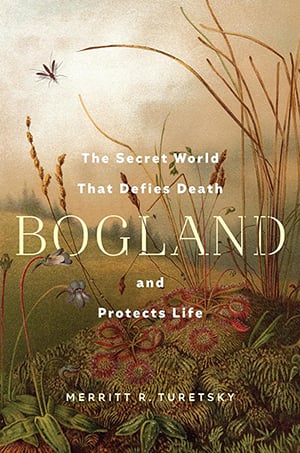
As a nursling of the rural Irish landscape, I was taken with the title of Merritt R. Turetsky’s book Bogland: The Secret World That Defies Death and Protects Life as bogs were a recurrent and onerous part of my childhood. The word ‘bog’ is deeply embedded in the Irish rural psyche, evoking generational resonances of social poverty, fuel, agricultural unproductivity, folklore and the uncanny. The ‘boggy’ land in my childhood context was the poorer land, the forgotten peripheral zones beyond high, dry fields that were worth more of the farmers’ attention. However, as a child who preferred to be alone, I found these boglands to be places where I could be left uninterrupted. Farmers didn’t notice you in their bog, because the bogs were ignored in plain sight. The same is still largely true today. Perhaps this book will change all that.
I had not so much forgotten as mislaid my memories of how astonishingly beautiful boglands are, until Turetsky lured me back. She describes them as places of historical fascination, liminal spaces between the dry land and waterscapes; blurry interstitial places that, in the same breath, are full of slow death and of complex life. Curiously, I had overlooked the presence of international boglands until I followed Turetsky’s fascinating and sometimes frightening fieldwork, peppered throughout her storytelling.
Turetsky weaves together the dead and life-filled cells of sphagnum mosses, tracing the evolution of boglands through to the more recent shameful extraction of peat for gardening purposes. Turetsky delves into the mysterious historical social engagement with boglands, bog burials, and the stratigraphic integrity of peat deposits as an irresistible auger into the distant past, conjuring stories of culture, resilience and ecology. I recall visiting my school friend’s house to explore the early internet with her engineer father, to gather background on the Tollund Man, and saving my findings on a floppy disc for an English class on Seamus Heaney’s poetry. I foraged information about the last meal the sacrificed man had consumed. The dark details about the texture of his skin. I remember how nervous I was reading my review aloud to the whole class, knowing they did not appreciate the beauty of boglands, ecology, or poetry. If only I had been armed with Turetsky’s fascinating work back then, I could have advocated for better bogland conservation to a whole classroom of farmers’ children.
There is something vulnerable about boglands; perhaps it is because they have been so misunderstood in recent history. Turetsky’s descriptions of the bogs resonate deeply with me, and they brought me back to the colours, smells, sounds, and otherness of these much-abused and sidelined places. Carnivorous plants, sphagnum mosses and nocturnal will-o’-the-wisps leading unsuspecting travellers to their doom. The enormous environmental benefits of conserving boglands shouldn’t be understated, and in her book, which I strongly recommend, Turetsky will explain why.
There is hope for the future of our boglands, but that depends on our participation and advocacy. Boglands: The Secret World That Defies Death and Protects Life is an important start toward conserving and re-appreciating some of our most precious and misunderstood landscapes.
Ben is a PhD Researcher at DkIT and Maynooth University, researching environmental aspect of the arts. He is a trained architect, urbanist, artist and gardener and cares for the natural world.