
How to move beyond your footprint and make a big impact
By Ryan Hagen
Climate Action Press, October 2025
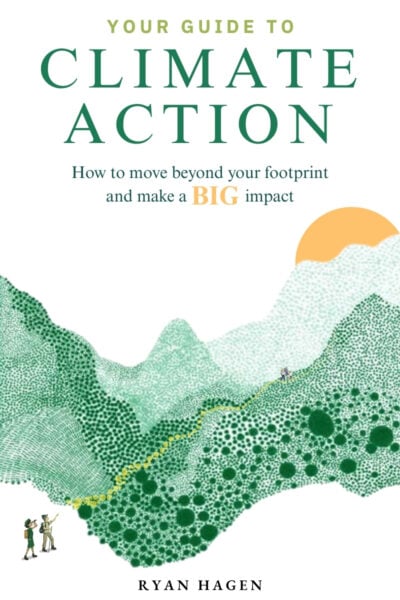
I have to admit, I opened Your Guide to Climate Action with a certain weariness, thinking it was yet another manual evaluating EV chargers and telling consumers how to recycle mixed plastics. So, I was pleasantly surprised to find that this action-oriented guide rightly puts the onus of the climate crisis back on the corporations and the government, then tells us where to go from there. Author Ryan Hagen is a self described “sustainability nerd,” and writes how the effects of climate will be much worse than we expect, but also that we can rebuild a better society much faster than most people think is possible. I was dubious about that rebuilding part, but by the end of the book I was buoyed by the advice, which describes how to effectively push back through the law and on the streets. I took refuge in Hagen’s citing of futurist Alex Steffen, who said that there is still a vast difference between the best and worst-case scenarios. In that space perhaps we can mine some hope.
Hagen is a very good communicator, and addresses issues that are often ignored, such as how to manage our emotions as we go through these trying times. He writes about how anxiety, grief, cynicism, and fatigue are “doing the job they evolved to do: keeping us alive. They’re providing us with useful feedback on the information we’re receiving on the environmental and social systems we exist in and rely on… They’re trying to give us the nudge we need to take actions that will help keep us alive.” I’ve always believed that action is the antidote to despair, but Hagen thinks that’s not enough. Quoting Dr. Britt Wray, he writes that the true antidote is “acknowledging your feelings, connecting with others who feel them, and taking aligned action.” These actions include the usual suggestions of powering with clean energy and eating less meat, but I lean into “rewiring democracies so that representatives are responsive to citizens rather than special interests.” The bottom line is power, and in the section about exercising that power, there is a chapter called “Talk About It!” That’s right, one of the key actions listed is simply talking. Quoting political scientist Elisabeth Noelle-Neumann, “People stay silent because they fear social isolation or losing something, like status, by speaking up.” Voting is another way of speaking up. In the chapter “Help Elect Climate Champions,” Hagen writes about the importance of staying connected for the sake of a democracy, along with good pointers on peaceful protesting and civil resistance.
Raise your hand if you have talked to folks who claim that a couple of degrees is just a “slightly warmer day,” and they look forward to milder winters. Next time, have Hagen’s response at the ready: “Imagine how you would feel if your body temperature went up by 2.7 C (4.9F). That would be a 103.5F fever, and you’d be bedridden.” Any higher than that “you’d be having seizures, organ failure, and permanent brain damage… or you’d be dead.” And yes, he backs it all up with citations and a lengthy list of resources at the back of the book. There is knowledge enough here for any reader, at any stage, no matter how many guides you’ve read before.

JoeAnn Hart writes about the pervasive and widespread effects of the climate crisis on the natural world and the human psyche. Her most recent book, Arroyo Circle, a story of reclamation in a time of loss, was released by Green Writers Press in 2024. Her other books include the prize-winning environmental and animal fiction collection Highwire Act & Other Tales of Survival, the crime memoir Stamford ’76: A True Story of Murder, Corruption, Race, and Feminism in the 1970s, as well as Float, a dark comedy about plastics in the ocean published by Ashland Creek Press, and Addled, a social satire. She is a regular reviewer of climate and animal fiction at EcoLit Books.