
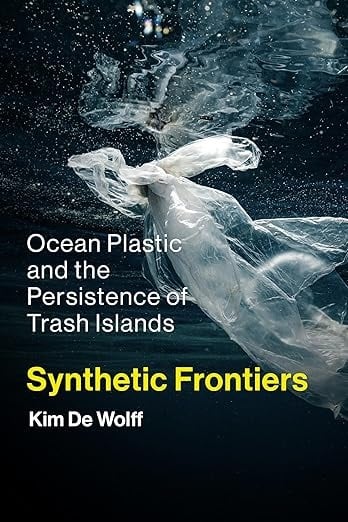
In the introduction to Synthetic Frontiers: Ocean Plastic and the Persistence of Trash Islands author Kim De Wolff writes:
Sail through the North Pacific Ocean and surely you cannot miss it: the Great Pacific Garbage Patch. It is massive and growing. An endless flow of plastic waste spun tight into an island by a spiraling gyre. Crowned the World’s Largest Landfill, the garbage patch contains an estimated 1.8 trillion pieces of plastic weight 3.5 million tons, spanning hundred of miles, and extending up to one hundred meters deep. … The Great Pacific Garbage Patch has grown so large that it is twice the size of Texas.
Except, no one can find.
And Kim De Wolff would know, as she spent considerable time on two research trips in futile search of this garbage patch. So why does the myth of this trash island carry so much figurate weight in our collective imaginations? This is one of the many questions De Wolff tackles in this thought-provoking book.
The author is not arguing that plastics in the ocean are a good thing but that good science is critical to ensuring we tackle the most important issues and she quotes a number of researches who have been frustrated by the myth of the trash island and all the many invented solutions intended to solve it.
One researcher calculated that if we took all of the plastic in all of the oceans, it would amount to 1.4 percent the size of the Texas, not twice the size of the Texas as the media has widely reported.
And even when researchers do encounter plastic, more questions come quite literally to the surface. Like the floating plastic crate that they came upon and were about to remove from the water when they realized that a number of small fish had colonized the crate because it offered safety from predators and food in the source of algae that was growing on the plastic.
To be clear, De Wolff is not arguing for more plastics in the ocean, but does provide a powerful argument that the truth about trash in the ocean is never quite so simple. In other words, one animal’s trash could be another’s treasure.
Ultimately, this is book that raises as many questions as it answers. Perhaps if we focused more on eliminating the demand for plastics and the production of plastics we would be more effective. Perhaps we inherently crave a simple solution — one mythological island upon which to focus our imagination and energies rather than an entire planet. As De Wolff writes:
Plastic’s persistence exceeds a physical mismatch of solutions, just as the trash island exceeds misrepresentation. As ongoing enactments of deeply embedded Western ontologies that expand synthetic frontiers, the garbage patch cannot be remedied with more “correct” science or journalism. Plastic demands accountability for the elemental terms upon which solidity and fluidity are understood, where islands come to matter.

John is an award-winning author of stories, novels and plays. He is author of THE STANDING DEAD, coming in 2027. He is also author of the novels The Tourist Trail and Where Oceans Hide Their Dead and co-author of the mystery Devils Island. He is editor of Writing for Animals (also now a writing program). More at JohnYunker.com.