
Dr. Ivan Pavlov is one of the most popular scientists of all time, so much so that his name has become an adjective.
And yet little is known about the man and his work — at least in the US. That’s partly because little of his writing was translated into English while he was alive. And, when it was translated, the end result was often poorly translated text.
For example, the term “conditional reflex” came out as “conditioned reflex” and you may see the mistranslation widely used today. This may appear trivial but it is not. Conditioned implies training and Pavlov was insistent that they did not train their dogs to do anything. Conditional indicated that reflexes could be developed but also eradicated, which is what he demonstrated through testing on dogs. And it was his testing on dogs that has long fascinated me. I assumed, as I imagine many do, that Pavlov’s tests on dogs were largely painless; after all, we’re talking about saliva right?
And yet to measure that saliva (or any juice that is created as part a food reflex) the dogs were operated upon to create openings for the juices to be collected. Not only saliva was collected, but also gastric and pancreatic juices, which required far more invasive (and risky) operations.
If this is news to you and you’d like to learn more about Pavlov, I first recommend two resources: The book Ivan Pavlov: A Russian Life in Science by Daniel P. Todes and the online exhibit Kingdom of Dogs.
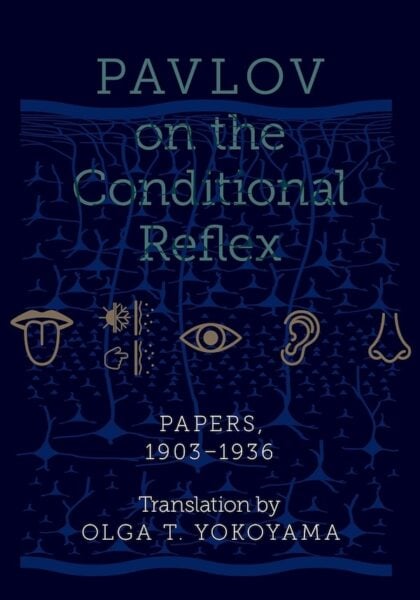
But if you want to take a much deeper dive into his work I recommend Pavlov on the Conditional Reflex: Papers, 1903– 1936, translated by Olga Yokoyama.
This is a scientific book. It includes Ivan Pavlov’s writings and speeches across three decades. But if you do read the book you’ll find that Pavlov doesn’t read academic. Most of what he wrote was initially delivered as a lecture and he was a very popular lecturer because he had a casual style of speech. And this is a big reason why a re-translation was so important. As Yokoyama writes in her fascinating introduction:
Style is the man himself: Buffon’s dictum le style est l’homme même (from his 1753 reception address at the French Academy) succinctly captured the idea that was formulated by many prominent intellectuals before and after him, including Goethe and Disraeli. An author’s diction is a part of him, and subliminal as it may sometimes be, it is revealing of the author perhaps even more than the content proper. That is why, in this translation of Pavlov, I have attempted to convey more than the content proper. The original Russian text contains so many linguistic features peculiar to Pavlov that ignoring or normalizing them— and many of them do not belong to what is normatively considered to be “good expository academic style”, so- called Western “textual grids”— seemed to be an unforgivable violation, as such “doctoring” would have altered “the man himself ”, along with changing his relationship to his assumed addressees.
Yokoyama’s introduction alone is a great read, providing so many insights into Pavlov’s use (or misuse) of the Russian language and how she aimed to translate not only the meaning of his words but the way he delivered them, writing: “Beyond factual accuracy, this translation also captures Pavlov’s style, the flow of his thought from one idea to the next, his reasoning from the experimental evidence to its analysis, and further to its implications.”
Pavlov pioneered animal testing by using state-of-the-art surgical facilities and methods to ensure that animals did not feel pain (at least until after the surgery). This may not seem revolutionary today but in the 1800s it was not unusual for scientists to skip using anesthesia entirely.
Pavlov’s dogs sometimes lived a number of years and participated in what Pavlov called “chronic experiments.” This type of research that is, tragically, still with us today.
Going back to the origins of modern animal research sheds light on how scientists came to view animals and their role in science, such as Pavlov’s edict against “anthropomorphizing” the dogs. And this despite the fact that every dog was given a name and not a number. Dr. Pavlov believed that dogs (and, eventually, chimps) would unlock insights into the human animal and he pursued this dream until the day he died. He will mostly be remembered for the conditional reflex — but, perhaps, in the future, also for the dogs he sacrificed for his science.
Perhaps no other scientist had such an impact on animals and science — then and today — than Ivan Pavlov.

John is an award-winning author of stories, novels and plays. He is author of THE STANDING DEAD, coming in 2027. He is also author of the novels The Tourist Trail and Where Oceans Hide Their Dead and co-author of the mystery Devils Island. He is editor of Writing for Animals (also now a writing program). More at JohnYunker.com.