
The extinction genre continues to expand and evolve as writers provide new and unique perspectives on the loss of animal species and how we come to terms with such losses. In Lost Animals, Disappearing Worlds: Stories of Extinction, author Barbara Allen gives voice to extinct species.
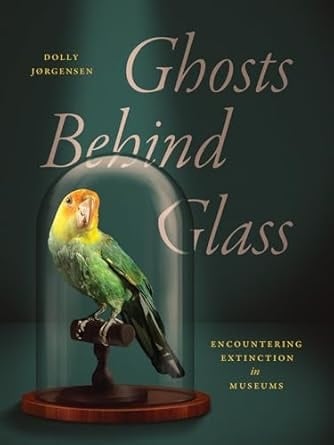
And in the book Ghosts Behind Glass: Encountering Extinction in Museums author Dolly Jorgensen provides a fascinating look at how extinction is presented by museums around the world. She visited (and photographed) natural history museums in more than 20 countries. The photographs alone (in full color) make this book a compelling read.
Jorgensen plays an engaging docent, taking us to museums in Tasmania (to see the thylacine) and Mauritius (to see the dodo) and Japan (the Japanese river otter). We also learn that some extinct species are widely dispersed around the world while others are quite rare; the dodo happens to be the most commonly displayed species in natural history museums.
We also meet many lesser known extinct species, such as the Steller’s sea cow, the Caribbean seal and the Delcourt’s gecko. Jorgensen notes that since the year 1500 approximately 776 species have been declared extinct, of which the majority are not on display in museums. Extinction is most often presented in the form of the larger species and mammals. Invertebrates, of which there have been far more documented extinctions, do not get nearly as much attention.
While dinosaurs are public favorites to see on a day out at the museum, amphibians, reptiles and fish that have become extinct in the modern era are rarely displayed for the public … They are rendered invisible.
Fortunately, some museums do make an effort to tell the stories of the smaller victims of extinction. Like Museo Nacioinal de Ciencias Naturales in Madrid. An exhibit on extinction features species you might expect, such as the dodo and giant moa, but it also dedicates space to Partula land snails, of which roughly half of the 80 or so species from the Pacific Islands are now extinct.
I learned a lot in the book, such as natural history museums are known as “dead zoos” and that museums may offer up conflicting accounts of the year of extinction and may not even declare a given species (such as the thylacine) extinct. Also interesting is not all museums make it clear that humans are the primary cause of the extinction of these animals (and perhaps that’s another reason why we prefer dinosaurs to, say, the Labrador duck).
The way an animal is presented to the public can play a role in how people perceive it. For example, she notes that birds displayed (fully stuffed) and in flight are far more engaging than bird bodies hung against the walls and also explain why both methods of display are valuable in connoting both the “aliveness” of the animal while also underscoring the tragic loss.
One weakness of the book is the extensive use of the “it” pronoun even in instances when the gender of the animal is known (or could be known). Only the few animals that were given names benefit from a “he” or “she.” And it’s striking how noticeable the shift in pronouns feels.
The animals with names — the endings or last of their species — are perhaps the saddest stories in the book. Billions of passengers pigeons were exterminated in North American in roughly 80 years but they are personified in Martha, the last known pigeon, who died at age 29 in an Ohio zoo in 1914.
Now I find myself with the urge to visit many museums around the world. But, until I do (or if I do not) I’m happy to have read this book and been given a wonderful tour along the way.

John is co-author, with Midge Raymond, of the mystery Devils Island. He is also author of the novels The Tourist Trail and Where Oceans Hide Their Dead. Co-founder of Ashland Creek Press and editor of Writing for Animals (also now a writing program). More at JohnYunker.com.