
This extraordinary book, intertwining psychology and ecology, takes a look at raising children and creating communities—from an Animal’s perspective. And it’s clear that we human animals can learn a great deal from the parenting models of the myriad nonhuman Animals featured in this book.
Among the first things readers may notice about The Evolved Nest: Nature’s Way of Raising Children and Creating Connected Communities is that Animal names are capitalized, consistent with traditions of tribal peoples and the names of human nations, and that gender-neutral pronouns are used for Animals (except when referring to a female mother or male father) instead of it. This is consistent with the book’s message that we need to remember our connection with Nature and the entire Animal kingdom, and not see nonhuman Animals as other but as far more similar to us than we believe.
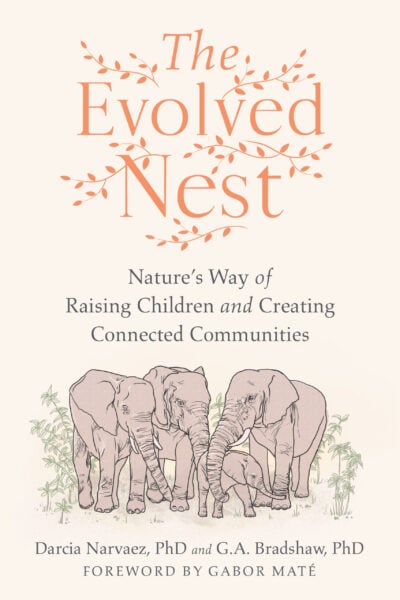
Given the “systemic social decay that ravages modern society: illness, addiction, child abuse, domestic violence, and suicide,” authors Darcia Narvaez and G.A. Bradshaw note that our distance from nature is, in fact, unnatural—it has taken us too far from the communities in which humans once lived and thrived. One specific example is the Amazonian Ye’kuana people, who lived in harmony in nature, where “humans thrived, water was clean and fresh, no one was homeless, and there was a deep sense of belonging.” As this well-researched and vividly detailed book reveals, the cultures of nonhuman animals also reflect such thriving communities.
When human culture shifted from living in harmony with nature to using plants and animals as commodities, the raising of children shifted as well: “Instead of positive, Nature-based ways, colonizing industrialized humans adopted what psychologists now understand to be a trauma-inducing lifestyle … Rather than being integrated in all aspects of a supportive community, most children’s experiences involve routine stress, isolation, and disconnection. In place of evolved nest inclusion, nurturance, and security, the unnested child experiences alienation, deprivation, and trauma, which often starts even prior to birth.”
The Evolved Nest reveals, through animals from Brown Bears to African Elephants to Gray Wolves, how the Animal kingdom is getting it right. “Although humans evolved to raise children together—grandmothers, fathers, kin and nonkin, and other mothers supporting mothers—our modern, individualistic society tends to forget that mothers require community support.” From pregnancy hormones to labor to post-birth, human mothers have a lot to contend with, while experiencing less support than ever. And these stressors affect children in myriad ways—even in nonhuman children, as shown in the example of how human violence induces trauma in African Elephants and how this reverberates in the Animal kingdom.
Humans won’t be surprised by some of the similarities we share with nonhuman Animals—all babies need warmth and security as well as nourishment—yet seeing how Animals raise their young offers important lessons. Like many humans who weigh the decision of whether to have children, Brown Bears ask, “Am I ready to care for my babies?” by delaying embryonic implantation if they don’t have the energy or resources to raise cubs. For all babies, “Without the foundations to provide resources of an evolved nest and a social and ecological world that can support the health of mind and body, a child’s future is precarious.”
And community is important and ever-present in most Animal cultures. When it comes to African Elephants, “At every moment during her pregnancy and throughout her entire life, a mother Elephant is accompanied by others … when an Elephant baby is born their transition from womb to Earth is unbroken. They enter the world welcomed, soothed, and safe through accompaniment by the entire group, much like human children are in humanity’s ancestral context.”
Likewise, Sperm Whales in the Azores share close family and social ties: “They spend the majority of their time together, in intimate contact.” Emperor Penguins share parenting duties, with the mother passing the egg to the father to incubate it while she forages—and community is especially important in Antarctica: the father Penguins huddle together to keep one another warm amid temperatures ranging from -40 to -120 degrees Fahrenheit. After the egg has hatched, Penguin babies are cared for by both parents and eventually a communal creche of juveniles.
In the Animal kingdom, there are no such things as feeding schedules, baby formula, or nannies. Animal babies, unless infected by human intervention, grow in communities, in harmony with their parents, in their own time. And, not surprisingly, Animal cultures make room for play, which is important to all young animals, human and nonhuman alike: “Social free play cultivates empathy and increases sensitivity and perceptions of emotions in others.” Yet while nonhumans prioritize play, the human animal often neglects this important part of learning, socialization, and joy. “Industrialized human societies … have turned away from play to a work-dominated culture … As our Animal kin demonstrate, however, play and work are intertwined. Although Wildlife must work very hard to make a living, play is central to their lives.”
Beavers, for example, are among the hardest working of the animal kingdom, yet while they are amazing architects and engineers, they also make time for play, such as swimming and diving in the water, and they’re affectionate; they kiss, groom, and snuggle. Affection and touch are part of all Animals’ lives: “All animals groom, and their reasons are similar”—a way to keep clean but also for communication and connection. For humans and nonhumans alike, “touch is how we become fully and intelligently embodied.”
The Evolved Nest asks us to notice not what makes us different from Animals but what makes us alike—“We share with Animals capacities for consciousness, feelings, thoughts, and dreams”—as well as how much our own activity imperils the very lessons they’re teaching us: “Unnested care is not found among nonhuman Animals unless they have been traumatized by human activities.” Gray Wolves, for example, who provide a wonderful example of raising their young to problem-solve, integrate body and mind, and foster community and cooperation, are suffering due to human extermination, leading to “severe trauma and loss of elder wisdom.”
In The Evolved Nest, Narvaez and Bradshaw weave together science, history, and psychology into a fascinating, relevant, and deeply thought-provoking work that shows how being connected to the natural world is necessary, not only to save our wild spaces and species but to save ourselves. “We can infuse and transform child-rearing, family life, communities, and relationships by revitalizing Nature-based values and an ethic of oneness.”

Midge Raymond is a co-founder of Ashland Creek Press. She is the author of the novels Floreana and My Last Continent, the award-winning short story collection Forgetting English, and, with John Yunker, the suspense novel Devils Island.