
The University of Chicago Press, 2025
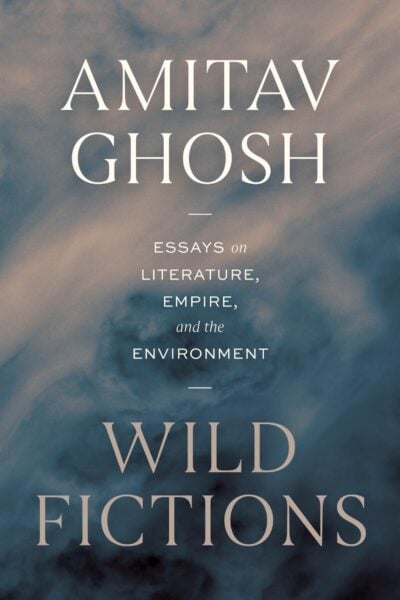
Among writers of climate and environmental fiction, Amitav Ghosh is known for his 2016 non-fiction book The Great Derangement, where he argues that fiction writers were ignoring climate catastrophes as if they were something out of science fiction and not appropriate for literary fiction. Ghosh is a fine writer of fiction himself,[1] but he is foremost an academic and historian with a deep knowledge of many topics, most relating to colonialism and his native India. Wild Fictions is a collection of his essays, correspondence, lectures (The Great Derangement itself sprung from a lecture series), and assorted articles. Not all of them directly address climate fiction, but most touch on the related topics of imperialism, power imbalances, and the debilitating costs of capitalism. He believes that the most pressing driver of climate change today is not carbon in the atmosphere, but wealth disparity, arguing that when a small percentage of the population controls almost all the resources, it is accompanied by a reckless disregard for the planet. He cites Hurricane Katrina as not so much a natural disaster as a convergence of climate, social, and historical factors, “an ever-increasing acceleration of economy and technology, production and consumption.”
In the introduction, Ghosh arrives in Sri Lanka soon after a terrorist attack in 2001, standing in a ravaged airport in what was once the most “advanced” (read: “Western”) nation in the Indian subcontinent. “The teleology that had sustained modernity, with its promises of never-ending growth and progress, was a delusion.” And with that, the tone and theme of the collection is set. In the title essay, “Wild Fictions,” originally published in Outlook[2] in 2008, he writes about “the destructiveness of greed,” and argues that there can be no balance except by placing limits on human desires in order to reset the relationship between humans and the natural world. He asks that we reimagine nature with a human presence, not as predator but partner. Indigenous human populations in wilderness areas are part of the landscape that need to be considered in protecting any ecosystem. “An untouched forest is a wild fiction.”
In “Imperial Denial,” first published in The Journal of Asian Studies, Ghosh has nothing kind to say about the Western approach to climate change, which strives to create an emissions regime that doesn’t change the global distribution of power. These mechanisms of imperialism and colonialism reveal themselves in almost every chapter, whether he’s writing about historical accounts or contemporary reality. In a lecture to the Arab Writers’ League Conference, he discusses how “untrammeled capitalism leads inevitably to imperial wars and the expansion of empires.” That argument need not look any farther than the United States now coveting Canada and Greenland, as climate change makes those countries warmer and their valuable resources more accessible. This marriage of imperialism and capitalism is unpacked in the essay, “The Spice Islands,” first published in Outlook, then later expanded into his book, The Nutmeg’s Curse. The Dutch became fabulously wealthy by controlling the production of nutmeg and cloves which grew on only a few islands, a control achieved through the massacre of the native populations.
It might look as if the grim history of Western imperialism would predict a dark future, but no. Ghosh offers life-affirming alternatives and, amazingly, still has great faith in humanity in spite of his subject matter. His final words in the book: “We are slowly beginning to understand that in order to hear the Earth, we must first learn to love it.”
[1] I can highly recommend The Glass Palace, his multi-generational saga set in India and Burma.
[2] A weekly general interest English and Hindi news magazine published in India.

JoeAnn Hart writes about the pervasive and widespread effects of the climate crisis on the natural world and the human psyche. Her most recent book, Arroyo Circle, a story of reclamation in a time of loss, was released by Green Writers Press in 2024. Her other books include the prize-winning environmental and animal fiction collection Highwire Act & Other Tales of Survival, the crime memoir Stamford ’76: A True Story of Murder, Corruption, Race, and Feminism in the 1970s, as well as Float, a dark comedy about plastics in the ocean published by Ashland Creek Press, and Addled, a social satire. She is a regular reviewer of climate and animal fiction at EcoLit Books.